-
896
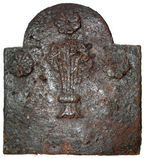
Description: Arched rectangular shape; no edging; three 'daisy' flowerheads, top centre and in each shoulder; central plume of six ostrich feathers issuing from what appears to be a wreath surmounting a tree stump.
Notes: Excavated from the ruins of Cloughoughter Castle in County Cavan, which had been rendered uninhabitable in a siege of 1653. Until the early 16th century the castle had been in the hands of the O'Reilly family. On some versions of the O'Reilly arms the crest is shown as a plume of ostrich feathers, although this may be a misrepresentation of the usual crest of a tree with a snake entwined about it.
- Decoration tags:
- rectangular with round arch (shape)
- none (edging)
- carved stamps
- heraldic
- plants
Manufactured: in the early-17th century in Ireland.
Current location: Parke's Castle, Fivemile Bourne, Co. Leitrim, Ireland.
(part of the Heritage Ireland museum group)
- Attached to series:
- Miscellaneous stamp firebacks
-
1267
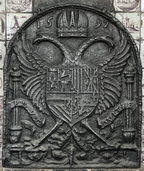
Description: Arched shape; cavetto moulded edge; double-headed eagle displayed, a Holy Roman Imperial crown above; in front, a quartered shield; a flaming pillar on each side, a motto scroll entwining each.
Notes: The shield bears the arms of Charles V, Holy Roman Emperor (reigned 1519-1556), king of Spain and nephew of Katherine of Aragon, Queen of England; the pillars are a symbolic representation of the Pillars of Hercules at the Strait of Gibraltar. Some variants of this fireback have a different date (e.g. see no. 627) or none at all.
Copies of this fireback are known.
Inscription: PLUS OVLTRE [Further Beyond]
Arms: Charles V, Holy Roman Emperor
- Decoration tags:
- rounded arched (shape)
- cavetto (edging)
- whole carved pattern
- individual numbers
- heraldic
- armorial
- royal
- text
Manufactured: in 1597 possibly in the Eifel area of Germany.
Current location: Owletts, The Street, Cobham, Kent, England.
(part of the National Trust museum group)
- Attached to series:
- Foreign armorial firebacks
-
1175
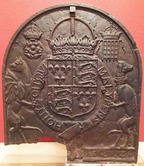
Description: Arch-shaped; fillet edge; Tudor shield, crown (with a circlet of acanthus leaves), garter (motto clockwise) and supporters. Crowned rose on dexter, and crowned portcullis (grid of 16) on sinister side of crown; the supporters, a dragon and a greyhound, stand on separate plinths; on the plinth below the greyhound is the number 28, probably half of the date 1528, the other part missing on the left side.
Notes: There are several firebacks with the Tudor royal arms that were probably produced in the Spanish Netherlands, perhaps illustrating the association between England and Spain through the marriage of Henry VIII and Katherine of Aragon. The firebacks differ in several small details, such as the form and rotation of the Garter motto, the style of the crown, the positioning of the supporters in relation to the Garter, and the form and size of the crowned rose and portcullis.
Inscription: HONY SOIT QVI MAL Y PENSE / 28
Arms: Tudor royal
- Decoration tags:
- rounded arched (shape)
- fillet (edging)
- whole carved pattern
- heraldic
- armorial
- royal
- text
Manufactured: in 1528 possibly in the Wallonia area of Luxemburg.
Current location: Consuegra, Toledo, Spain.
- Attached to series:
- Tudor royal armorial firebacks
- Continental Tudor royal armorial firebacks
-
1023
Description: Canted rectangle; hatched fillet edging (top and sides); initials in triad to the left; fleur-de-lys stamp repeated seven times across top; date and initial pairs below; full width, horizontal hatched fillet below inscription; zig-zag formed of short, hatched fillets down each side below horizontal fillet; space within bordered by squared cross stamp repeated 12 times horizontally and six times on each side.
Notes: The distinctive squared cross and fleur stamps are seen on other firebacks; the initials in triad may relate to a husband and wife, the pairs of initials to their children; an almost identical fireback (no. 1314) seen at Smith's Funeral Services, close to the site of Elmbridge Furnace, at Newent, Gloucestershire, differs only in the alignment of the left-hand column of squared crosses.
Inscription: AHE [triad] 1671 WH MH
- Decoration tags:
- rectangular with canted top corners (shape)
- hatched fillet (edging)
- simple stamps
- carved stamps
- individual letters
- individual numbers
- heraldic
- text
- objects
Manufactured: in 1671 possibly at Elmbridge Furnace, Newent in the Forest of Dean area of England.
Current location: in private hands, Coombes, West Sussex, England.
- Attached to series:
- Newent area group
- Square cross Dean series 1
- Fleur-de-lys firebacks
-
1035
 ? x ? mm
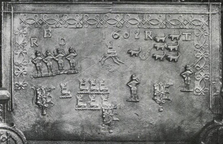
Description: Rectangular with furniture-derived mounding (top and sides); double-loop 'lens' pattern stamp repeated inside the moulded edging nine times along the top and three times down each side; top left, initials RBD in triad; right of top centre, date 1602; top right, initials RT split between two repeated dog stamps; four other dog stamps in pairs below, and one below date; becapped human figure stamp, with his left arm raised to his head and his right arm akimbo, repeated four times below initial triad and two singly, one below lone dog stamp and one centre right; top centre, stamp of a crest formed of a stag 'lodged' (i.e. sitting) upon a wreath, in this instance only with pseudo legs drawn below, also repeated six times in two rows of three left of lower centre, with one to the left of the six; 'renaissance' shield bearing initials 'IE' linked with twisted cord, repeated lower left and right with a third bottom centre impressed partially over the centremost stag crest.
Notes: A fireback remarkable for the haphazard arrangement of groups of seemingly unrelated stamps. Acquired in 1900 by Sir Spencer Maryon-Wilson for Charlton House (Country Life, 23 April 1904, from whence has come the illustration); several of the stamps have been noted on two other firebacks, both dated 1617, and suggesting by their location an origin in the Horsham area of the Weald.
Inscription: R B D [triad] 1602 R T / IE IE / IE
- Decoration tags:
- rectangular (shape)
- furniture moulding (edging)
- carved stamps
- heraldic
- monogram
- text
- animals
- humans
Manufactured: in 1602 in the Weald area of England.
Current location: not known.
Citation: Gardner, J. S., 30 Apr 1904, 'An old fire-back' (letter), Country Life, p. 647.
Citation: S. M. W. [Spencer Maryon-Wilson], 23 Apr 1904, 'An old fireback' [letter], Country Life, p. 611.
Citation: Shuffrey, L. A., 1912, The English Fireplace, London, Batsford.
-
1221
 ? x ? mm
Description: Arched rectangular central panel with bead on broad fillet edging; lattice basket standing on a ground, with flowers and fruit issuing therefrom in a symmetrical display; arched rectangular border with fillet edging; on each side, mirrored vine with flowers and leaves suspended from mirrored swirled foliage; at the bottom, the letter W in a cartouche between swirled foliage; on top, mirrored swirled foliage issuing upwards from a mythical creature on each shoulder.
Notes: The floral theme and its execution shows parallels with the SHR, N and 1724 series of firebacks and could be from the same workshop. The 'W' initial probably denotes the pattern maker.
Inscription: W
Manufactured: in the late-17th to early-18th century in England.
Current location: not known.
Citation: Anon., 2 Dec 1905, 'Old Kent and Sussex Fire-backs', Country Life, pp. 767-768.
- Attached to series:
- W series
- British 'Dutch' style firebacks
- Fruit basket firebacks
-
37
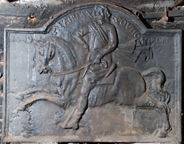
Description: Arched rectangular shaped; cavetto moulded edging; male figure in dress of the period, right hand on hip, left hand holding reins, astride a prancing horse; date and inscription (letter 'N' reversed) follow inside top edge.
Notes: Thomas Fairfax, 3rd Lord Fairfax of Cameron (1612-1671), commander of the New Model Army, which probably prompted the epithet, conqueror. 1649 was the year of Charles I's execution, to which Fairfax was opposed. Copies were advertised in Longden & Co.'s (Sheffield) catalogue c.1911, and in the Carron Company's catalogue.
Copies of this fireback are known.
Inscription: 1649 LD FAIRFAX COVNQVIROR
- Decoration tags:
- rectangular with round arch (shape)
- cavetto (edging)
- whole carved pattern
- pictorial
- historical
- text
- animals
- humans
Manufactured: in 1649 in England.
Current location: in private hands, Cowbeech, East Sussex, England.
- Attached to series:
- Commemorative firebacks
-
968
Description: Rectangular; truncated egg and dart moulded edging on top and left side; top right of centre, date in individual over-pressed stamps; initials in over-pressed stamps centred below date.
Notes: A rare use of egg and dart moulding used as separate edging, presumably derived from redundant domestic moulding or furniture.
Inscription: 1637 / H V
- Decoration tags:
- rectangular (shape)
- egg and dart (edging)
- individual letters
- individual numbers
- text
Manufactured: in 1637 possibly in the Weald area of England.
Current location: in private hands, Cowden, Kent, England.
- Attached to series:
- Date & initials firebacks
-
969
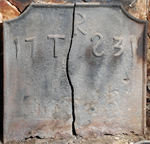
Description: Cavetto-canted rectangular shape; astragal edging (top and sides); letters in triad between separated date.
Notes: The modest size of this fireback reflects the decreasing size of fireplaces in the 18th century.
Inscription: 17 TRS [triad] 31
- Decoration tags:
- rectangular with canted top corners (shape)
- astragal (edging)
- individual letters
- individual numbers
- text
Manufactured: in 1731 in the Weald area of England.
Current location: in private hands, Cowden, Kent, England.
- Attached to series:
- Date & initials firebacks
-
888
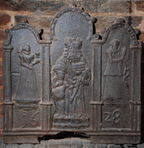
Description: Triple arched rectangular shape, centre arch higher; each arch supported by pilasters; within centre arch, cloaked, bearded male figure wearing a crown and carrying a ewer and what appear to be a pile of plates; in left arch, above first half of date, a clothed female figure carrying a goblet and possibly a candle on a staff; in the right arch, above the second half of the date, a clothed female figure holding a distaff and a length of wool; there is a narrow panel at the bottom; on the outside of the arches are scroll-shaped protusions.
Notes: The shape of this fireback is relatively uncommon, and the significance of the figures may relate to a particular narrative.
Inscription: 16 28
- Decoration tags:
- rectangular with three arches (shape)
- complex individual (edging)
- carved stamps
- whole carved pattern
- individual numbers
- architectural
- text
- humans
Manufactured: in 1628 possibly in the Eifel area of Germany.
Current location: in private hands, Cowden, Kent, England.
- Attached to series:
- Figurine firebacks