-
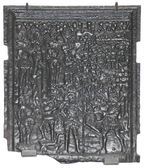
776
Description: Stove-plate; poss. fragment; rectangular; flanged edging on top and sides; pictorial scene illustrating the biblical tale of Joshua and the five kings.
Notes: Joshua 10.
- Decoration tags:
- rectangular (shape)
- flanged (edging)
- whole carved pattern
- pictorial
- biblical
- humans
Manufactured: in the mid- to late-16th century possibly in the Eifel area of Germany.
Current location: Victoria & Albert Museum, Cromwell Road, Kensington & Chelsea, Greater London, England.
Museum number: 289.1923 (part of the Victoria & Albert Museum museum group)
- Attached to series:
- Stoveplates
-
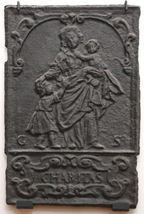
777
Description: Rectangular; cavetto-moulding within a flanged edge; floriate arch above a female figure with a child in her left arm and another by her right side, initials split by the group; below a simulated rope-twist fillet, elaborate floriate cartouche containing the word, CHARITAS.
Notes: A late stove-plate, illustrated in von den Driesch p.484.
Copies of this fireback are known.
Inscription: G S / CHARITAS
- Decoration tags:
- rectangular (shape)
- flanged (edging)
- whole carved pattern
- pictorial
- allegorical
- text
- humans
Manufactured: in the late-17th century in the Siegerland area of Germany.
Current location: Victoria & Albert Museum, Cromwell Road, Kensington & Chelsea, Greater London, England.
Museum number: 890.1901 (part of the Victoria & Albert Museum museum group)
- Attached to series:
- Stoveplates
-
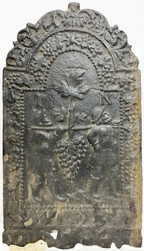
1274
Description: Arched rectangular central panel with bead edging; image of two helmeted men in 17th century dress, on a ground, carrying a huge bunch of grapes slung from a pole between them, behind are vine leaves; the initials located below the top corners; arched rectangular border, fillet edging, containing vine leaves and grapes; above, symmetrical swirling foliage descending from a scallop shell; bottom of the image obscured by corrosion damage.
Notes: The scene, drawn from the Old Testament, represents Joshua and Caleb carrying the bunch of grapes from the valley of Eshcol in the land of Canaan, back to Moses and the children of Israel (Numbers 13: 23-4); a popular subject on a variety of media in the period.
Inscription: I N
Manufactured: in the mid- to late-17th century possibly in the Siegerland area of Germany.
Current location: Victoria and Albert Museum, Cromwell Road, Kensington and Chelsea, London, England.
Museum number: M.372-1912 (part of the Victoria & Albert Museum museum group)
- Attached to series:
- Joshua and Caleb firebacks
- Old Testament & Apocrypha firebacks
-
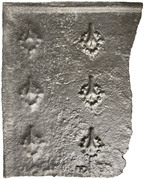
1067
Description: Fragment; rectangular shape; ovolo-moulded edging (top and sides); six stamps, in two columns of three, taking the form of a long-pointed arrow head within a circlet of small curls.
Notes: The stamps are of an unfamiliar type with some similarity to the heraldic symbol for ermine. Because only the left part of the fireback has survived it is not known how many original columns of this stamp there were.
- Decoration tags:
- rectangular (shape)
- ovolo (edging)
- carved stamps
- heraldic
Manufactured: in the 16th century possibly in the Weald area of England.
Current location: Victoria and Albert Museum, Cromwell Road, Kensington and Chelsea, London, England.
Museum number: M.148-1915 (part of the Victoria & Albert Museum museum group)
- Attached to series:
- Miscellaneous stamp firebacks
-
1140
Description: Arched rectangular shape with arch on top; rebated fillet edging; below mirrored putti holding crossed fronds, the figure of St George slaying the dragon; on each side a flame-topped column.
Notes: The central panel of what would otherwise have been a typical bordered fireback intended for the Dutch market.
- Decoration tags:
- rectangular with arch above arch (shape)
- whole carved pattern
- pictorial
- historical
- animals
- humans
Manufactured: in the mid- to late-17th century in the Siegerland area of Germany.
Current location: Victoria & Albert Museum, Cromwell Road, Kensington & Chelsea, London, England.
Museum number: 797-1899 (part of the Victoria & Albert Museum museum group)
- Attached to series:
- 'Dutch' Miscellaneous Firebacks
-
1227
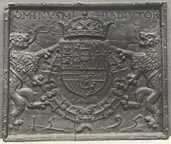
Description: Rectangular shape with ovolo-moulded edging; within the collar of the Order of the Golden Fleece, a central shield of the arms of Spain: quarterly Castile and Leon, Aragon and Aragon-Sicily, with an escutcheon of Portugal; in base Austria, Burgundy ancient, Burgundy modern and Brabant with an escutcheon of Flanders impaling Tyrol; above, a crown; supporters: two golden lions rampant; below the shield, the date, 1595; above the crown, the inscription: Dominus mihi adiutor (the Lord is my helper).
Notes: The arms of King Philip II of Spain following the unification with Portugal, as used in the Spanish Netherlands. Part of the bequest to the Victoria and Albert Museum by Lieut. Colonel G. B. Croft-Lyons in 1926.
Copies of this fireback are known.
Inscription: DOMINVS MIHI ADIVTOR
Arms: King Philip II of Spain (Spanish Netherlands)
- Decoration tags:
- rectangular (shape)
- ovolo (edging)
- whole carved pattern
- heraldic
- armorial
- royal
- text
- animals
Manufactured: in 1595 possibly in the Ardennes area of Belgium.
Current location: Science Museum, Exhibition Road, Kensington & Chelsea, London, England.
Museum number: M.624.1926 (part of the Victoria & Albert Museum museum group)
- Attached to series:
- Foreign armorial firebacks
-
1063
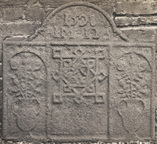
Description: Composite of three elements; central panel has a complex ‘knot’ pattern with a fillet edge; side panel, repeated on either side of the central panel, contains a vase of flowers, possibly stylised thistles, within an arched frame and fillet edge; arched panel above, also with fillet edge, contains the date and inscription; the spandrels of the side panels, and the arched top panel, contain a series of circular motifs comprising concentric rings deepening towards the centre.
Notes: ‘Knot’ patterns were popular in gardens of the period. The garden theme is continued with the side panels. An example of the same design, noted at Linchmere, West Sussex, is a different casting, the top panel with the date and initials being slightly askew. From a photograph in the Victoria and Albert Museum, London; photographed at Mapesbury House, Willesden in 1904.
Copies of this fireback are known.
Inscription: 1598 / IM IB
- Decoration tags:
- rectangular with round arch (shape)
- astragal (edging)
- carved pattern panels
- text
- plants
- objects
Manufactured: in 1598 in the Weald area of England.
Current location: not known.
Museum number: E.4376-2000 (part of the Victoria & Albert Museum museum group)
- Attached to series:
- Armada series
- Garden design types
-
895
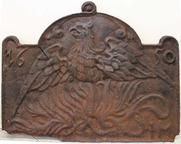
Description: Quasi-arched rectangular shape, semi-circular protrusions on top corners; cavetto-moulded edging looped at top; two mirrored scrolls inside arch; a phoenix in flames, its wings displayed and inverted; date, in two parts, in top corners; initials in bottom right corner.
Notes: On a copy (no. 590) the loop at the top is missing and the date and the initials have been erased. Copies of this fireback were advertised in Bratt Colbran Ltd.'s (London) catalogue in the early-20th century.
Copies of this fireback are known.
Inscription: 16 50 / IM
- Decoration tags:
- rectangular with round arch (shape)
- cavetto (edging)
- whole carved pattern
- pictorial
- mythological
- text
- animals
Manufactured: in 1650 possibly at Brede Furnace in the Weald area of England.
Current location: not known.
- Attached to series:
- Hooked '1' series
- IM series
- Loop edged firebacks
- Brede group
- Phoenix firebacks
-
1326
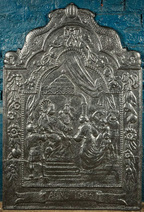
Description: Arched rectangular central panel with additional arch above; bead edging; pictorial scene of Solomon, seated on a scallop-backed, canopied throne, greeting the Queen of Sheba, with other figures in attendance; identical shaped border with fillet edging; a vase on top with descending vines with leaves and fruit; at the sides, festoons of flowers suspended from ribbon bows; at the bottom, a symmetrical folded motto scroll with 'ANNO 1603' in the centre; on top, a Roman Imperial crown between a descending serpent on each side.
Notes: The date is spurious, this style of fireback not being made until after 1650. Several contemporary paintings are of similar scenes; this design may have been derived from a Dutch engraving of a drawing by an anonymous French artist after Maarten van Heemskerck. The same central panel can be seen on no. 1289.
Inscription: ANNO 1603
Manufactured: in the mid- to late-17th century in the Siegerland area of Germany.
Current location: not known.
-
1171
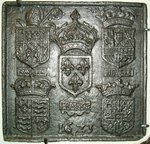
Description: Rectangular shape; fillet edging; arrangement of five shields: centre, arms of the kingdom of France surmounted by a crown and, below, the word FRANCE on a fillet edged rectangular block over a cartouche; top left, arms of the duchy of Lorraine surmounted by a bishop's mitre and crozier separating a largely illegible text; top right, arms of the kingdom of Spain surmounted by a crown with the letters SPA to the left; bottom right, arms of the duchy of Nevers surmounted by a coronet below a fillet edged rectangle with the word NEVERS; bottom left, arms of the kingdom of England surmounted by a crown below a fillet edged rectangle with the word ANGLIA; bottom centre, the date 1623.
Notes: A taque de foyer or takenplatte; the arms in the corners are likely to be of (from top left): Louis III of Lorraine, Archbishop of Reims; King Philip III of Spain; Charles I, Duke of Nevers and Rethel; and Queen Elizabeth I of England. A similar fireback with the same arms, illustrated by von den Driesch (1990, p.181), has the date 1611, but the absence of a cardinal's hat over the arms of Louis of Lorraine suggests that the fireback originally dates from before 1605.
Inscription: [LORR]AI[NE] SPA / ANGLIA NEVERS / FRANCE / 16z3
Arms: Louis of Lorraine; Kingdom of Spain; Kingdom of France; Kingdom of England; Charles Gonzaga, Duke of Nevers
- Decoration tags:
- rectangular (shape)
- fillet (edging)
- whole carved pattern
- individual numbers
- heraldic
- armorial
- royal
- text
Manufactured: in 1623 possibly in the Ardennes area of Belgium.
Current location: Musée Gaumais, 38 Rue d'Arlon, Virton, Luxembourg, Belgium.
(part of the Musée Gaumais, Virton museum group)
- Attached to series:
- Foreign armorial firebacks