-
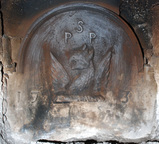
501
Description: Arched rectangular shape; ovolo-moulded edging; central crest of a gryphon's head couped, its wings displayed; above, the initials, the 'S' above the 'P's; below, the date.
Notes: The crest is likely to be that of Peter Short of Lindfield, Sussex, who married Philadelphia Burrell in 1704.
Inscription: PSP / 1730
Arms: Short of Lindfield
- Decoration tags:
- rectangular with round arch (shape)
- ovolo (edging)
- carved stamps
- individual letters
- individual numbers
- heraldic
- text
Manufactured: in 1730 possibly in the Weald area of England.
Current location: in private hands, Newick, East Sussex, England.
- Attached to series:
- Personal firebacks
- 1730s-40s, date & initial series
-
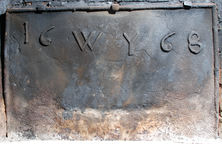
504
Description: Rectangular; twisted rope edging (top and sides); along upper half of plate, date split with initials in between.
Notes: The initials are likely to be those of William Yalden (d.1674), an ironmaster who was active in north-west Sussex and south-west Surrey where this and other similar firebacks have been noted.
Inscription: 16 WY 68
- Decoration tags:
- rectangular (shape)
- rope (edging)
- individual letters
- individual numbers
- text
Manufactured: in 1668 in the Weald area of England.
Current location: in private hands, Northchapel, West Sussex, England.
- Attached to series:
- William Yalden series
-
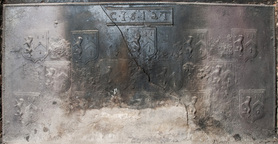
1316
Description: Rectangular; twisted rope edging on top and sides; cavetto-moulded-edged rectangle top centre (left side missing), enclosing date between initials; 14 shields of Ayloffe impaling Sulyard in three rows (5-4-5); Ayloffe: sable, a lion rampant Or, collared gules, between three crosses formy of the second; Sulyard: argent, a chevron gules between three pheons inverted sable.
Notes: William Ayloffe (c1535-1584) of Bretons, Hornchurch, Essex, Justice of the Court of Queen’s Bench, married (c1560) Jane, dau. of Sir Eustace Sulyard, of Runwell, Essex. The initials 'CT' are likely to be those of Charles Tyler, a founder whose working life and that of his family have strong parallels with the occurrence of these firebacks. The excrescences between some of the shields are the result of inexpert ladling of the iron during casting. The absence of the left side of the frame of the inscription panel has also been noted on another back in this series, also dated 1612.
Inscription: C.1.6.1.2.T
Arms: Ayloffe impaling Sulyard (William Ayloffe of Bretons, Hornchurch)
- Decoration tags:
- rectangular (shape)
- rope (edging)
- carved stamps
- individual letters
- individual numbers
- armorial
- text
Manufactured: in 1612 possibly at Bedgebury Furnace, Goudhurst in the Weald area of England.
Current location: Great Dixter, Northiam, East Sussex, England.
- Attached to series:
- Ayloffe series
- Personal armorial firebacks
-
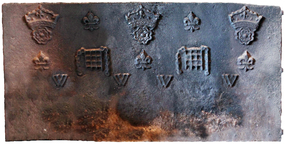
1222
Description: Rectangular shape; no edging; symmetrical arrangement of four stamps: across the top, three crowned roses with a fleur-de-lys between each pair; across the middle, three fleurs-de-lys with a chained portcullis between each pair; below and in the spaces between the fleurs and portcullises, four letters W.
Notes: The letter W may have an apotropaic significance; the stamps have not been recorded on other firebacks.
Inscription: W W W W
- Decoration tags:
- rectangular (shape)
- none (edging)
- carved stamps
- heraldic
- apotropaic
- text
- objects
Manufactured: in the late-16th century possibly in the Weald area of England.
Current location: Great Dixter, Northiam, East Sussex, England.
- Attached to series:
- Miscellaneous royal firebacks
- Fleur-de-lys firebacks
-
1317
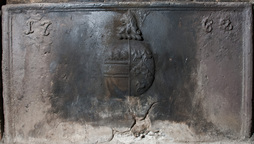
Description: Rectangular; cavetto-moulded edging (top and sides); date, in s florid style, split between top corners; central oval shield of impaled arms surmounted by a crest of a lion's head erased upon a wreath.
Notes: George Worge (1705-65), of Starr’s Green, Battle, sometime steward of the Battle Abbey estate, married Elizabeth (1707-66), eldest daughter of John Collier, town clerk of Hastings, in 1727. The arms of Worge have been variously blazoned, but most commonly they are: gules, a fess ermine cotised argent, in chief three lion’s heads erased of the last; Collier - argent, on a chevron azure, between three unicorns courant couped gules, as many oak sprigs fructed proper. The arms and crest in the same form can be seen on a fireback with an elaborate border (no. 757).
Inscription: 17 62
Arms: Worge impaling Collier (George and Elizabeth Worge)
- Decoration tags:
- rectangular (shape)
- cavetto (edging)
- carved stamps
- individual numbers
- heraldic
- armorial
- text
Manufactured: in 1762 probably at Robertsbridge Furnace, Salehurst in the Weald area of England.
Current location: Great Dixter, Northiam, East Sussex, England.
- Attached to series:
- Worge/Collier series
- Personal armorial firebacks
-
710
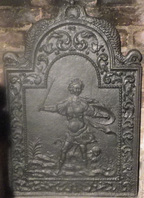
Description: Arched rectangular central panel with bead edging; figure of a man with a shield, brandishing a sword in his right hand, a lion behind him; arched rectangular border with astragal and fillet edging; mirrored swirled foliate design; on top, a scallop shell between two descending sea serpents.
Notes: The figure is probably Hercules who was charged by Eurystheus to slay the Nemean lion, one of his 12 labours.
Copies of this fireback are known.
- Decoration tags:
- 'Dutch' (shape)
- astragal & fillet (edging)
- whole carved pattern
- pictorial
- mythological
- animals
- humans
Manufactured: in the mid- to late-17th century in the Siegerland area of Germany.
Current location: Great Dixter, Northiam, East Sussex, England.
- Attached to series:
- 'Dutch' Miscellaneous Firebacks
-
1144
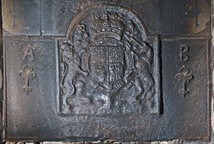
Description: Composite; arched rectangular shaped, armorial fireback, cavetto edging, with Stuart Royal arms, garter, supporters, crown and motto, and 1662 date above crown; this overlies a rectangular plate with fillet edging; top centre in the space each side of the central shield, an initial letter - A to left, B to right - each above a fleur-de-lys, its stem terminating in a small buckle.
Notes: Several firebacks have incorporated the same Stuart royal shield, which probably originally dated to 1619, but with the date altered. A similar fireback, but without the initials and fleurs-de-lys, dated 1661, and reputed to have come from the Totsey, the old guildhall at the market cross in Gloucester, is illustrated in Ames, 1980, 23; possibly the same fireback was reported by the late David Bick to be at The Grange, Minsterworth, Gloucestershire (demolished in the late 1960s).
Inscription: 16 62 / [Garter motto (illeg.)] / A B
Arms: English Stuart royal
- Decoration tags:
- rectangular with round arch (shape)
- fillet (edging)
- carved stamps
- carved pattern panels
- composite
- individual letters
- heraldic
- armorial
- royal
- text
Manufactured: in 1662 possibly in the Forest of Dean area of England.
Current location: in private hands, Norton, Wiltshire, England.
Citation: Ames, A., 1980, Collecting Cast Iron (Ashbourne, Moorland Publishing).
Citation: Badeni, J., 22 Sep 1983, 'Whose Fireback?' [letter], Country Life, 174, 4492, p. 772.
-
505
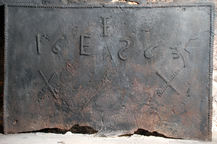
Description: Rectangular; twisted rope edging (top and sides); inscription (‘S’ reversed) across upper middle of plate, with superscripted central ‘I’ (crossed) ; below each part of the date is a twisted rope saltire (145mm lengths).
Notes: A personal fireback, made to order; a similar commission by Giles Moore, Rector of Horsted Keynes, Sussex, in 1657, cost 13 shillings.
Inscription: I / 16 E S 63
- Decoration tags:
- rectangular (shape)
- rope (edging)
- simple stamps
- individual letters
- individual numbers
- apotropaic
- text
- objects
Manufactured: in 1663 in the Weald area of England.
Current location: in private hands, Ockley, Surrey, England.
- Attached to series:
- Date & initials firebacks
- Rope design firebacks
-
1086
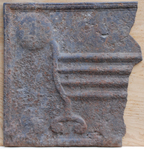
Description: Fragment; rectangular shape; ovolo-moulded edging; image of an iron grate with barred front and integral andiron with iron or brass disc.
Notes: A unique example; it is not certain how the mould was formed, whether by impressing an actual grate or carving a pattern with the image of a grate; the former seems more likely.
- Decoration tags:
- rectangular (shape)
- ovolo (edging)
- simple stamps
- objects
Manufactured: in the mid- to late-17th century possibly in the Weald area of England.
Current location: in private hands, Outwood, Surrey, England.
- Attached to series:
- Miscellaneous pattern firebacks
- Metalware stamp firebacks
-
1141
Description: Arched rectangular shape; twisted rope edging (top and sides); date stamp, 1634, in arch; initials, EH, separated by a cross, below date.
Notes: The same date stamp has been noted on another fireback; the cross between the initials may have an apotropaic purpose.
Inscription: 1634 /E + H
- Decoration tags:
- rectangular with round arch (shape)
- rope (edging)
- simple stamps
- individual letters
- date stamp
- apotropaic
- text
- objects
Manufactured: in 1634 in England.
Current location: Newark Park, Ozleworth, Gloucestershire, England.
(part of the National Trust museum group)
- Attached to series:
- 1634 stamp series