-
472
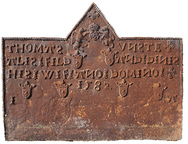
Description: Rectangular with central triangular arch; twisted rope edging (top and sides); in arch, on top, a small cross formed of fleurs-de-lys above a rose and crown with dragon and lion supporters above two crowned shields each bearing a small fleur-de-lys; text across top half, a small cross formed of fleurs-de-lys ending the first and third lines, the top two lines split by the crowned shields, each word separated by two opposed fleurs; below the text, four crowned shields each with a fleur-de-lys, the date between the middle two; lower left, 'I'; lower right, 'A'.
Notes: The inscription can be interpreted as Thomas Anstie alias Field and Denise his wife (etc.), the surname Anstie alias Field being known in the 16th century in central Sussex. A Thomas Anstye married Denys Joyner at Wivelsfield, Sussex on 5th June 1564; illustrated in Lower, 1849 p. 189 with some errors in transcription of the inscription; formerly at 'Misfield' (Miswell), Worth, Sussex. One of a small series of distinctive firebacks cast in 1582, most with inscriptions dedicated to pairs of individuals; the initials IA are likely to be of the founder as they appear in the same arrangement on the other firebacks; the rose and crown and supporters stamp can also be seen on a large fireback, dated 1593, formerly at Baynard's Park, Surrey (no. 200).
Inscription: THOMAS VNSTE / ALIS : FILD AND DINIS / HIS : WIF: ANO : DOMINO: / 1582 / I A
- Decoration tags:
- rectangular with triangular arch (shape)
- rope (edging)
- carved stamps
- individual letters
- individual numbers
- heraldic
- text
Manufactured: in 1582 possibly at Pounsley Furnace, Framfield in the Weald area of England.
Current location: Gwesty Seren Hotel (formerly Bryn Llewellyn), Allt Goch, Llan Ffestiniog, Gwynedd, Wales.
- Attached to series:
- Pounsley series
- 1582 IA series
-
975
 ? x ? mmImage subject to copyright
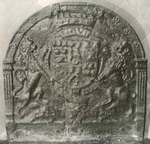
Description: Arched shape; double-fillet edged arched border, with six evenly-spaced roses, resting on pilasters; shield, supporters, garter and coronet of the Earl of Exeter; plain rectangular bottom panel.
Notes: The arms are of the earldom of Exeter, which was created in 1605 for Thomas Cecil, 2nd Lord Burghley (1542-1623).
Inscription: HONY SOIT QVI MAL Y PENSE [illegible]
Arms: Cecil, Earls of Exeter
- Decoration tags:
- rounded arched (shape)
- fillet (edging)
- whole carved pattern
- armorial
Manufactured: in the early-17th century in Wales.
Current location: Plas Llanmihangel, Llanmihangel, Glamorgan, Wales.
Museum number: GL 7628 (part of the National Monuments Record of Wales museum group)
- Attached to series:
- Personal armorial firebacks
-
467
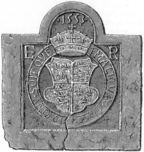
Description: Arched rectangular with plain edges; arched rectangular inset with cavetto edging and armorial design in low relief: circular garter enclosing an ornate Tudor royal shield, surmounted by a crown; date inside top of arch; initials inside top corners of rectangle
Notes: Discovered by Mr Anthony Hill of the Plymouth ironworks, Glamorgan, in the 1820s, and believed by David Mushet, in his 'Papers on Iron and Steel' to have been cast at the early furnace on the opposite side of the River Taff; a variant of the same date (no. 288) has an inscription on the bottom panel and roses in relief at the bottom corners of the rectangle, which may have been obliterated by fire damage on this casting, the drawing showing it how the artist thought it might have looked originally. The west country source for both of these firebacks offers the possibility of an origin in those parts.
Inscription: HONV SOIT QVE MALE V [illegible]
Arms: Tudor royal - Edward VI
- Decoration tags:
- rectangular with round arch (shape)
- none (edging)
- whole carved pattern
- armorial
- royal
- text
Manufactured: in 1553 .
Current location: not known.
Citation: Mushet, D., 1840, Papers on Iron and Steel (London, John Weale), p. 393.
- Attached to series:
- Edwardian royal armorial firebacks
- Tudor royal armorial firebacks
-
468
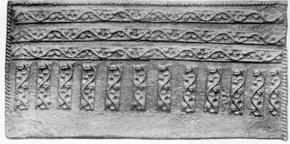
Description: Rectangular; twisted rope edging (top and sides); stamp formed of a bordered strip with an undulating vine with grapes and leaves, repeated six times in three horizontal rows of two; below, a short piece of the same strip positioned vertically and repeated twelve times.
Notes: The vine strip features on many firebacks indicating a common source. Illustration from Lloyd, 1925.
- Decoration tags:
- rectangular (shape)
- rope (edging)
- simple stamps
- carved stamps
- objects
Manufactured: in the mid- to late-16th century possibly at Pounsley Furnace, Framfield in the Weald area of England.
Current location: not known.
Citation: Lloyd, N., 1925, 'Domestic Ironwork I', Architectural Review, 58, pp. 58-67.
- Attached to series:
- Pounsley series
- Vine strip series
- Furniture stamp firebacks
-
469
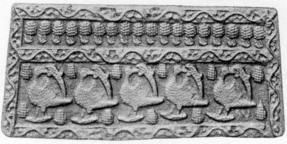
Description: Quasi-rectangular; edging formed of repeated bordered strip with undulating vine with fruit and leaves; horizontal line of two uneavenly repeated vine strips dividing the plate into two compartments, the upper comprising a grape bunch repeated eighteen times, the lower comprising a bird (probably a swan, a Lancastrian badge), its head turned to its left and one visible wing displayed and inverted, repeated five times with a grape bunch repeated twelve times at the ends and between each swan on the top and bottom of the compartment.
Notes: The vine strip, swan and grape bunch stamps feature on many firebacks indicating a common source. Illustration from Lloyd, 1925.
- Decoration tags:
- rectangular (shape)
- trailing vine (edging)
- simple stamps
- carved stamps
- heraldic
- animals
- plants
- objects
Manufactured: in the mid- to late-16th century possibly at Pounsley Furnace, Framfield in the Weald area of England.
Current location: not known.
Citation: Lloyd, N., 1925, 'Domestic Ironwork I', Architectural Review, 58, pp. 58-67.
- Attached to series:
- Pounsley series
- Vine strip series
- Swan series
- Furniture stamp firebacks
-
471
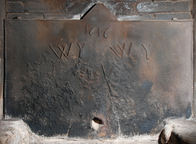
Description: Rectangular with small central triangle on top; twisted rope edging (top and sides) and across base of triangle; top centre, date, centrally positioned above the separated pairs of initials, WY; below and right of centre, rope saltire; bottom centre, a hole apparently puncturing the plate from behind.
Notes: The initials are those of William Yalden (1580-1659), an ironmaster who was active in north-west Sussex and south-west Surrey where this and other similar firebacks have been noted. The saltire is likely to have had an apotropaic purpose. Although undoubtedly connected with the builder of the house wherein it rests, the fireback pre-dates the building, which was erected in 1640.
Inscription: 1616 / WY WY
- Decoration tags:
- rectangular with triangular arch (shape)
- rope (edging)
- simple stamps
- individual letters
- individual numbers
- apotropaic
- text
Manufactured: in 1616 in the Weald area of England.
Current location: in private hands, Lodsworth, West Sussex, England.
- Attached to series:
- William Yalden series
- Rope design firebacks
-
1060
 ? x ? mm
Description: Central shield bearing a lion rampant reguardant, with esquire's helm and crest of a seated hawk, surrounded by foliage and tasselled ribbons; twisted rope edging at each side; the shape of the fireback is dictated by the decorative elements; initials split by shield, the date similarly split below the initials.
Notes: Drawing of a fireback from old premises, formerly a baker's, opposite 20 Love Lane (later known as Lovat Lane), which ran between Eastcheap and Lower Thames Street; the arms appear to be those of the Morrice family (blazon: gules, a lion rampant reguardant or). Drawn by Charles Raymond Booth Barrett, 1891. A fireback of unique design.
Inscription: W M / 15 86
Arms: Morrice or Maurice
- Decoration tags:
- complex individual (shape)
- complex individual (edging)
- whole carved pattern
- heraldic
- armorial
- text
- plants
Manufactured: in 1586 possibly in the Weald area of England.
Current location: not known.
Museum number: SC/GL/PR/370/LOV/1/q7706298 (part of the London Metropolitan Archives museum group)
Citation: Windyer Morris, G. T., 4 Oct 1902, 'Arms on Fireback', Notes and Queries, 9th series, 10, p. 278.
- Attached to series:
- Miscellaneous pattern firebacks
- Personal armorial firebacks
-
964
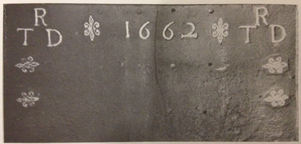
Description: Rectangular; Twisted rope edging (top and sides); top centre, date; initials in triad in top corners; a double fleurs-de-lys between date and each set of initials, and two rotated down each side of the plate.
Notes: Formerly at a cottage in Bradford's Lane, Newent, Gloucestershire. Illustration from Bick 1987.
Inscription: TRD / 1662 / TRD
- Decoration tags:
- rectangular (shape)
- rope (edging)
- carved stamps
- individual letters
- individual numbers
- heraldic
- text
Manufactured: in 1662 in the Forest of Dean area of England.
Current location: The Glasshouse Inn, May Hill, Longhope, Gloucestershire, England.
Citation: Bick, D. E., 1987, The Mines of Newent and Ross, (Newent, The Pound House), p. 35.
- Attached to series:
- Miscellaneous stamp firebacks
- Fleur-de-lys firebacks
-
1005
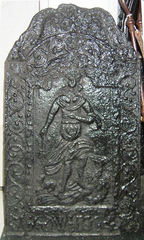
Description: Arched rectangular central panel within double fillet foliate edging; pictorial scene of a crudely modelled clothed female figure holding a wand? in the right hand; indistinct pictorial element to bottom right; arched rectangular border with fillet edging containing repeated swirled decoration; on top, two mirrored sea monsters.
Notes: A crude pastiche of the 'Dutch' style of fireback; the central figure may be Hera with a peacock. Formerly at the Raleigh Trevelyan estate, St Cadix, Cornwall.
Inscription: WHC[?]
- Decoration tags:
- 'Dutch' (shape)
- fillet (edging)
- whole carved pattern
- pictorial
- mythological
- text
- animals
- humans
Manufactured: in the early-18th century in England.
Current location: Deja Vu Antiques, 31 Fore Street, Lostwithiel, Cornwall, England.
- Attached to series:
- British 'Dutch' style firebacks
-
474
Description: Fragment; arched rectangular shape with rounded corners; ovolo within fillet moulding all round; oval Tudor royal shield with garter surrounding, topped with a royal crown; dragon and greyhound supporters; initials split by crown; inscription on a fillet between legs of supporters, behind garter finial; motto on an Ionic plinth at bottom; left hand rectangular extension panel with twisted rope edging on top and side: initials in top left corner, ‘dragon’s head’ in top right corner, rose-en-soleil stamp in centre, rose stamp bottom centre.
Notes: The letters on the extension panel are the same form and size as those on the top of the armorial pattern, indicating that they were added to the armorial, perhaps to indicate a change of reign. The letter 'E' has also been noted on another fireback of the same series. The rose-en-soleil was the badge of King Edward IV and, thus, a Yorkist symbol; it is seen on other firebacks. From a house in Chailey, Sussex. Illustration from Lower (1849).
Inscription: E R / E / R / HONY SOIT QUE MAL Y PAYNCE / Made in Sussex by John Harvo / DV ET MOVN DR...
Arms: Tudor royal
- Decoration tags:
- rectangular with round arch (shape)
- complex individual (edging)
- carved stamps
- whole carved pattern
- individual letters
- armorial
- royal
- text
- animals
- plants
Manufactured: in the mid- to late-16th century in the Weald area of England.
Current location: not known.
- Attached to series:
- Pounsley series
- John Harvo series
- Rose-en-soleil series