-
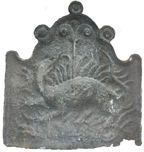
891
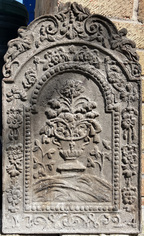
Description: Quasi-arched rectangular shaped; unique, cavetto-moulded edging, which loops upon itself three times. A mythical salamander shown in the flames which legend states it is able to resist; behind is what appears to be a palm tree.
Notes: Other known variants are dated; this variant confirms that the dates were added to subsequent castings. Corrosion to the bottom right corner may have obliterated a letter 'M' seen on another casting; presumably part of 'IM'.
- Decoration tags:
- rectangular with ornate arch (shape)
- cavetto (edging)
- whole carved pattern
- pictorial
- mythological
- animals
Manufactured: in the mid-17th century possibly at Brede Furnace in the Weald area of England.
Current location: not known.
Citation: Schubert, H. R., 1957, 'A Forgery in Iron', Journal of the Iron & Steel Institute, 165, p. 125.
- Attached to series:
- Hooked '1' series
- Loop edged firebacks
- Brede group
-
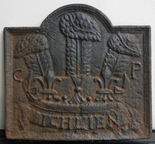
198
Description: Arched rectangular shape; cavetto-moulded edging; English royal coronet with three ostrich feathers rising from within; below, a motto scroll with inscription.
Notes: The badge of the Prince of Wales; the initials, CP, are probably for Carolus Princep; the motto is mis-spelled in error for 'Ich Dien' - I serve, which is more likely a mistranscription rather than a deliberate slur. The apparent crack in the angle of the arch and the top left of the fireback is an impression, indicating that this is a recasting.
Copies of this fireback are known.
Inscription: C P/ICH LIEN
- Decoration tags:
- rectangular with round arch (shape)
- cavetto (edging)
- whole carved pattern
- heraldic
- royal
- text
Manufactured: in the mid-17th century possibly in the Weald area of England.
Current location: not known.
- Attached to series:
- Prince of Wales firebacks
-
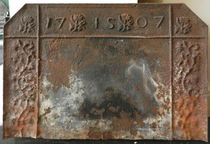
910
Description: Canted rectangle; cavetto-moulded edging (top and sides); single horizontal fillet below canted corners and vertical fillet parallel to each side, dividing the fireback into two side panels, two top corner panels, top panel and main central panel; corner panels, ‘daisy’ plant stamp; top panel, central initials between split date, separated by 'daisy' stamps; side panels, swirling foliage stamp repeated each side, initial at bottom of panel: I to the left, B to the right.
Notes: The 'daisy' stamp and the IB initials are found on other backs in a distinct series. The foliage stamp is not known on other backs in the series. Christie's Interiors - Masters & Makers (Sale 5462), South Kensington, London, 8 July 2014, lot 126 (£688).
Inscription: 17 IS 07 / I B
- Decoration tags:
- rectangular with canted top corners (shape)
- cavetto (edging)
- carved stamps
- individual letters
- individual numbers
- text
- plants
Manufactured: in 1707 in the Forest of Dean area of England.
Current location: not known.
- Attached to series:
- IB series
-
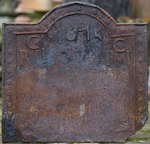
978
Description: Arched rectangular shape; twisted rope edging with inaccurately parallel arched rectangular fillet inside, enclosing repeated small fleur-de-lys stamps along sides and top; initials in triad in each of the internal top corners; date in arch.
Notes: The initials probably relate to a couple whose surname begins with C, the husband's forename initial being R and the wife's I (or J).
Inscription: RCI/ 1675 / RCI
- Decoration tags:
- rectangular with round arch (shape)
- rope (edging)
- simple stamps
- carved stamps
- individual letters
- individual numbers
- heraldic
- text
Manufactured: in 1675 in England.
Current location: not known.
- Attached to series:
- Miscellaneous stamp firebacks
-
1248
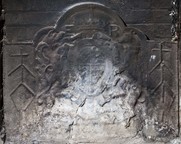
Description: Central arched rectangular shape with rounded corners; ovolo moulding all round; oval Tudor royal shield with garter surrounding, topped with a royal crown; dragon and greyhound supporters; initials split by crown; all details below shield illegible; rectangular extension panels on each side, with twisted rope edging; quasi mirrored arrangement of twisted rope lengths to form (from the top) a cross, a vertical pointing arrow, and a diamond shape with a central vertical line.
Notes: The detail of the extension panel is sharper than the armorial, indicating that the panel was cast with a worn copy of the armorial. Illustrated in Weaver, 1914, p. 16.
Inscription: E R [+ Garter, Harvo and royal mottoes, all illegible]
Arms: Tudor royal (prob. Henry VIII)
- Decoration tags:
- rectangular with round arch (shape)
- rope and ovolo moulding (edging)
- simple stamps
- whole carved pattern
- extension panels
- heraldic
- apotropaic
- armorial
- royal
- text
- objects
Manufactured: in the late-16th to early-17th century in the Weald area of England.
Current location: in private hands, Plaistow, West Sussex, England.
Citation: Weaver, L., 1914, Small Country Houses: their repair and enlargement (London, Country Life).
- Attached to series:
- Pounsley series
- John Harvo series
- Tudor royal armorial firebacks
-
586
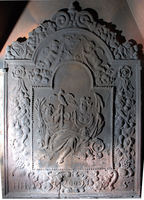
Description: Arched rectangular shaped central panel with bead edging; pictorial scene of a seated female figure resting against a hurdle, holding an anchor, a child on each side of her, the one on the left standing clutching corn stalks, the one on the right sitting also holding the anchor and a circular object; a bird sits on a post; arched rectangular border with bead edging; fructal and floral festoons suspended on ribbons with two putti at the top and two on each side; in the left and right bottom corners, the initials 'HH' and 'S' respectively; at the bottom, a central cartouche with date, between floral swags; on top, twin spirals between descending floral festoons.
Notes: The figure is an allegory of Hope. The theft in 1699 from a Thames-side warehouse of several firebacks, including '3 of Hope with an Anchor' may refer to this type (Post Boy 11-14 Nov. 1699).
Copies of this fireback are known.
Inscription: HH 1665 S
- Decoration tags:
- 'Dutch' (shape)
- ovolo (edging)
- whole carved pattern
- pictorial
- allegorical
- text
- animals
- humans
- objects
Manufactured: in 1665 in the Siegerland area of Germany.
Current location: in private hands, Plaxtol, Kent, England.
- Attached to series:
- 'Dutch' HHS series
- Hope firebacks
-
587
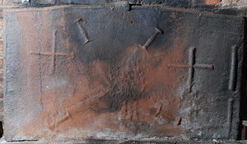
Description: Quasi-rectangular; grooved dowel edging (top and sides); four impressions of a rondel dagger (c.330mm) saltirewise between two dowel crosses; two vertical lengths of dowel in line along right edge.
Notes: Rondel daggers were common in the 15th and 16th century. Grooved lengths of dowel are to be seen on other firebacks suggesting a common source. The arrangement of the daggers (each approx. 35cm long) in a saltire may also have apotropaic significance.
- Decoration tags:
- rectangular (shape)
- grooved dowel (edging)
- simple stamps
- apotropaic
- objects
Manufactured: in the mid-16th century in the Weald area of England.
Current location: in private hands, Plaxtol, Kent, England.
- Attached to series:
- Grooved dowel series
- Knife & Dagger stamp firebacks
-
1322
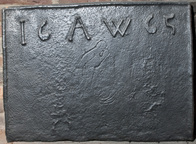
Description: Quasi-rectangular shape; twisted rope edging (top and sides); top, initials 'A W' between split date '1665', the '1' of a different character set to the other numbers.
Notes: The distinctive form of the '5' identifies this fireback in a series with other firebacks; the '1' is also peculiar to the series. The curious intaglio shape in the middle of the plate may have resulted from a length of string or thin cord left on the surface of the mould when the iron was poured.
Inscription: 1 6 A W 6 5
- Decoration tags:
- rectangular (shape)
- rope (edging)
- simple stamps
- carved stamps
- individual letters
- individual numbers
- text
Manufactured: in 1665 in the Weald area of England.
Current location: in private hands, Pulborough, West Sussex, England.
- Attached to series:
- Shortened '5' series
-
1191
Description: Rectangular; twisted rope edging (top and sides only); eight shields of Ayloffe impaling Sulyard in three rows, 3-2-3; Ayloffe: sable, a lion rampant Or, collared gules, between three crosses formy of the second; Sulyard: argent, a chevron gules between three pheons inverted sable.
Notes: William Ayloffe (c1535-1584) of Bretons, Hornchurch, Essex, Justice of the Court of Queen’s Bench, married (c1560) Jane, dau. of Sir Eustace Sulyard, of Runwell, Essex. Illustrated in Lloyd (1925).
Arms: Ayloffe impaling Sulyard (William Ayloffe of Bretons, Hornchurch)
- Decoration tags:
- rectangular (shape)
- rope (edging)
- carved stamps
- heraldic
- armorial
Manufactured: in the early-17th century in the Weald area of England.
Current location: Great Dixter, Northiam, East Sussex, England.
Citation: Lloyd, N., 1925, 'Domestic Ironwork I', Architectural Review, 58, pp. 58-67.
- Attached to series:
- Ayloffe series
- Personal armorial firebacks
-
549
Description: Arched rectangular shaped central panel, bead on fillet edging, narrow-necked urn with flowers issuing therefrom; arched rectangular shaped border with fillet edging and symmetrical floral festoons; on top, stylised fish with floral accessories; at bottom, two looped 'W' figures between date split between bottom corners.
Notes: The smallest of six flower vase designs in this series. All incorporate the looped 'W' motif which may be intended to identify the pattern maker. The small size of this fireback makes it likely that it was intended to be fixed to the back of a grate. Reeman Dansie auction, Colchester, 30 Sep 2025, lot 5292 (£46).
Copies of this fireback are known.
Inscription: 17 24
Manufactured: in 1724 in England.
Current location: not known.
- Attached to series:
- 1724 series
- British 'Dutch' style firebacks