-
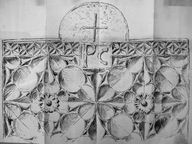
1083
Description: Arched rectangular shape; fillet edging (top and sides); twisted rope cross in centre of arch; fillet-edged square below arch containing initials of uneven size; along the top, a line of five quatrefoils on each side of the initials; below, two symmetrically carved roundels and associated spandrels, each with a central flower.
Notes: The quatrefoils and roundels are likely to have been part of a redundant, probably medieval, furniture panel, perhaps from a chest. The life-size rubbing, reinforced with ink, is by W. R. Lethaby. The fireback was formerly property of the artist John Callcott Horsley RA (1817-1903) at Wilsley Green, Cranbrook, Kent.
Inscription: PC
- Decoration tags:
- rectangular with round arch (shape)
- fillet (edging)
- carved pattern panels
- apotropaic
- text
- objects
Manufactured: in the mid- to late-16th century possibly in the Weald area of England.
Current location: Victoria & Albert Museum, Cromwell Road, Kensington & Chelsea, London, England.
Museum number: 3267-1932 (part of the Victoria & Albert Museum museum group)
Citation: Lethaby, W. R., 1 Oct 1926, 'English Cast Iron - I', The Builder, 131, no. 4365, pp. 537-8.
- Attached to series:
- Miscellaneous pattern firebacks
-
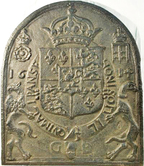
1137
Description: Arched shape with ovolo-moulded edging; central shield with the English royal Tudor arms and an inescutcheon of a lion rampant, surrounded by a Garter with an incorrect inscription, the shield surmounted by a crown and supported on the dexter side by a dragon and on the sinister side by a greyhound; to the left of the crown, a crowned rose and the the right, a crowned portcullis; above the supporters the date 1614 is split by the shield; below, split by the Garter buckle, initials GB.
Notes: The arms are of Henry VII or Henry VIII, the inescutcheon probably representing a marriage to an heiress, but are anachronistic as the date was in the reign of James I (and VI). The initials GB are believed to relate to Gilles or Georges Boniver, who worked at the foundry at Theux, near Liège, and whose initials appear on several firebacks. The fireback is thought to be a 19th-century copy.
Copies of this fireback are known.
Inscription: 16 14 / HONI SOIT IL QVIMAL I PANSE / G B
Arms: English royal Tudor with an inescutcheon of a lion rampant
- Decoration tags:
- rounded arched (shape)
- ovolo (edging)
- whole carved pattern
- heraldic
- armorial
- royal
- text
Manufactured: in 1614 probably at Theux Furnace in the Franchimont area of Belgium.
Current location: M-Museum Leuven, 28-30 Leopold Vanderkelenstraat, Leuven, Brabant, Belgium.
(part of the Leuven Museum museum group)
-
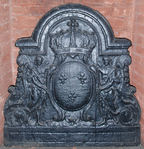
828
Description: Upon a rectangular base plinth with an inscribed rectangle, to each side, a wide foliate scroll; central cartouche behind an oval shield bearing three fleurs-de-lys over a horizontally textured ground, supported on each side by a draped male figure, the whole surmounted by a French royal crown; on top, an arch rising from horizontal moulding on each side.
Notes: Characteristic of designs illustrated by architects such as Daniel Marot; the texturing on the shield indicates the azure tincture.
Arms: French royal
- Decoration tags:
- rectangular with round arch (shape)
- complex individual (edging)
- whole carved pattern
- planklines
- armorial
- royal
Manufactured: in the late-17th to early-18th century in France.
Current location: in private hands, Lewes, East Sussex, England.
- Attached to series:
- Foreign armorial firebacks
-
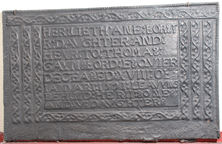
369
Description: Quasi-rectangular shape; rope edging on top and sides; central inscription panel; repeated trailing vine decoration from impressed wooden strips — one horizontal line at top, three vertical strips at each side, one horizontal strip below panel, plain panel at base.
Notes: A series of firebacks all bearing the inscription carved onto a panel and included with other stamps in the casting of the iron graveslab covering the tomb of Anne Forster (Foster) in St George’s church, Crowhurst, Surrey. Formerly in the John H. Every Collection, for which it was purchased in 1921 at Isfield Place, Sussex.
Inscription: HER : LIETH : ANE : FORST/ R : DAVGHTER : AND : / HEYR : TO : THOMAS : / GAYNSFORD : ESQVIER / DECEASED : XVIII : OF: / IANVARI : 1591 : LEAVYNG / BEHIND : HER II : SONES : / AND : V : DAVGHTERS
- Decoration tags:
- rectangular (shape)
- rope (edging)
- simple stamps
- carved stamps
- planklines
- text
- objects
Manufactured: in the late-16th century possibly at Pounsley Furnace, Framfield in the Weald area of England.
Current location: Anne of Cleves House, Southover High Street, Lewes, East Sussex, England.
Museum number: 1944.24.043 (part of the Sussex Archaeological Society museum group)
-
370
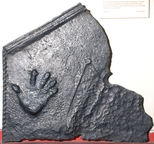
Description: Fragment; left side only; twisted rope edging to left, canted moulded batten above; left hand print with dividers to its right.
Notes: An unusual combination of edging. The dividers may refer to the occupation of the person for whom this fireback was cast. Formerly in the collection of Dr C. L. Prince of Crowborough, Sussex.
- Decoration tags:
- rectangular with canted top corners (shape)
- rope and wood moulding (edging)
- simple stamps
- humans
- objects
Manufactured: in the mid- to late-16th century in the Weald area of England.
Current location: Anne of Cleves House, Southover High Street, Lewes, East Sussex, England.
Museum number: LH000.798 (part of the Sussex Archaeological Society museum group)
Citation: Anon., 30 Dec 1911, 'Sussex Backs and their Story', The Ironmonger.
Citation: Dawson, C., 1903, 'Sussex Iron Work and Pottery', Sussex Archaeological Collections, 46, pp. 1-54.
Citation: Gardner, J. S., 1898, 'Iron Casting in the Weald', Archaeologia, 56, 1, pp. 133-164.
- Attached to series:
- Hand print firebacks
- Metalware stamp firebacks
-
371
Description: Rectangular; twisted rope edging (top and sides); top row, two square-within-a-square arrangements of twisted rope between three stamps formed of Gothic tracery cresting; 2nd row, two more tracery cresting stamps (the one on the right over stamping a fleur-de-lys) between two crowned, star-embossed butter mould stamps with a crowned rose-en-soleil stamp in the middle; 3rd row, three star-embossed butter mould stamps with two pairs of fleurs-de-lys between them; bottom row, seven fleurs-de-lys; plus interspersed short rope lengths, and a vertical, double zig-zag arrangement of rope lengths on each side.
Notes: The rose-en-soleil was the badge of King Edward IV and, thus, a Yorkist symbol. Many of the stamps employed on this fireback are seen, with other stamps, on a wide variety of firebacks, suggesting a common source; similar gothic tracery stamps can be seen as pierced cresting on a rare late-Medieval, wooden Easter sepulchre at the redundant church of St Michael at Cowthorpe, North Yorkshire. Another fireback with an almost identical arrangement of the same stamps has also been noted (no. 713).
- Decoration tags:
- rectangular (shape)
- rope (edging)
- simple stamps
- carved stamps
- heraldic
- objects
Manufactured: in the mid- to late-16th century possibly at Pounsley Furnace, Framfield in the Weald area of England.
Current location: Anne of Cleves House, Southover High Street, Lewes, East Sussex, England.
Museum number: LH000.940 (part of the Sussex Archaeological Society museum group)
-
372
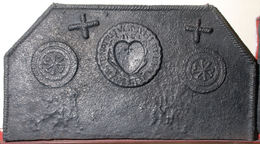
Description: Rectangular with canted top corners; twisted rope edging all round except on bottom; three impressions of two circular wafering irons: the central one with invected edge, a heart surmounted by a cross beneath which scroll-work is arranged symmetrically, inscription around edge; the two outer stamps comprise a central motif of four hearts arranged in a cross shape, their points facing the centre, within two concentric bands decorated with lace-like patterns. Above each of the two outer stamps is a simple four-pointed cross shape formed from short lengths of twisted rope.
Notes: The use of wafering irons or butter prints as stamps in casting firebacks is infrequent. Formerly part of the J. H. Every collection.
Inscription: ...N:YOU:NOT: REIVE:MY:HERT:IS:YOURES / [?]1562
- Decoration tags:
- rectangular with canted top corners (shape)
- rope (edging)
- simple stamps
- apotropaic
- text
- objects
Manufactured: in 1562 in the Weald area of England.
Current location: Anne of Cleves House, Southover High Street, Lewes, East Sussex, England.
Museum number: 1944.24.048 (part of the Sussex Archaeological Society museum group)
Citation: Hughes, G. B., 1960, Collecting Antiques (London, Country Life), pp. 85-93.
Citation: Hughes, G. B., 21 Apr 1955, 'Old English Firebacks', Country Life, 117, pp. 1056-60.
Citation: Hughes, G. B., May 1940, 'Old English Firebacks', Apollo, 31, 185, pp. 117-120.
- Attached to series:
- Food mould stamp firebacks
- Heart cross stamp series
-
373
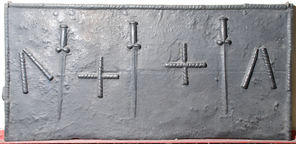
Description: Rectangular, edged with twisted leather lengths on top and sides; a ballock dagger with hollow-ground cruciform blade, point down, impressed vertically three times and evenly spaced across the width of the back; between each, two short lengths of twisted leather, arranged in a cross; at either end, the same short lengths of dowel arranged in an inverted ‘V’.
Notes: The dagger (length approx. 38cm) dates from c1575-1625. The probable use of twisted leather is seen occasionally on other firebacks. The grouping of three daggers may also have apotropaic significance in relation to the Trinity.
- Decoration tags:
- rectangular (shape)
- twisted leather (edging)
- simple stamps
- planklines
- apotropaic
- objects
Manufactured: in the late-16th to early-17th century in the Weald area of England.
Current location: Anne of Cleves House, Southover High Street, Lewes, East Sussex, England.
Museum number: 1944.24.035 (part of the Sussex Archaeological Society museum group)
- Attached to series:
- Knife & Dagger stamp firebacks
-
374
Description: Quasi-rectangular; twisted rope edging (top and sides); a length of twisted rope stamped six times to form a saltire and two crosses across the width of the plate; surplus iron extends from all sides.
Notes: The surplus iron resulted from over filling of the mould. The crosses are likely to have Christian significance. Formerly part of the J. H. Every collection.
- Decoration tags:
- rectangular (shape)
- rope (edging)
- simple stamps
- apotropaic
- objects
Manufactured: in the mid- to late-16th century in the Weald area of England.
Current location: Anne of Cleves House, Southover High Street, Lewes, East Sussex, England.
Museum number: 1944.24.037 (part of the Sussex Archaeological Society museum group)
Citation: Hughes, G. B., May 1940, 'Old English Firebacks', Apollo, 31, 185, pp. 117-120.
- Attached to series:
- Rope design firebacks
-
375
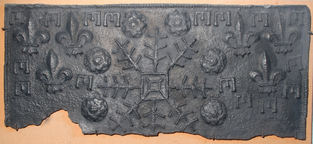
Description: Rectangular; twisted rope edging (top and sides); central rope carbuncle with eight arms, with a rose between each of the top six pairs of arms; a fleur-de-lys repeated six times in two triads (2-1) in each top corner; a letter ‘E’ rotated clockwise repeated 8 times along the top between the fleurs and roses, and twice down each side; four additional ‘E’s, one to the left of the carbuncle and three to the right.
Notes: All the stamps can be seen on other firebacks associating them with the same source; The ‘E’s are identical to those seen on the John Harvo armorial fireback. The elaborate central rope array may be an interpretation of the escarbuncle, which was the principal heraldic charge on the arms of the Duchy of Cleves, possibly associating this fireback with the brief marriage of Henry VIII and Anne of Cleves. Formerly part of the J. H. Every collection.
- Decoration tags:
- rectangular (shape)
- rope (edging)
- simple stamps
- carved stamps
- heraldic
- text
- objects
Manufactured: in the mid- to late-16th century possibly at Pounsley Furnace, Framfield in the Weald area of England.
Current location: Anne of Cleves House, Southover High Street, Lewes, East Sussex, England.
Museum number: 1944.24.076 (part of the Sussex Archaeological Society museum group)
Citation: Hughes, G. B., 1960, Collecting Antiques (London, Country Life), pp. 85-93.
Citation: Hughes, G. B., May 1940, 'Old English Firebacks', Apollo, 31, 185, pp. 117-120.
- Attached to series:
- Pounsley series
- Fleur-de-lys firebacks