-
99
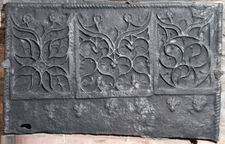
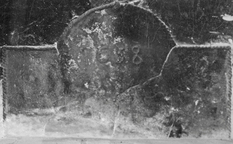
Description: Quasi-rectangular; twisted rope edging (top and sides); three gothic panels arranged horizontally, the centre one wider than the other two, each panel a symmetrical arrangement of tracery patterns with an inverted ogee arch on top incorporating two flowers; below are six, irregularly spaced fleurs-de-lys.
Notes: The panels were probably derived from a dismantled wooden chest or hutch table, c.1500. Their gothic style belies the probable age of the fireback, such chests already being old when their parts might have been re-used. The same panels are on a fireback at East Grinstead Museum.
- Decoration tags:
- rectangular (shape)
- rope (edging)
- carved pattern panels
- architectural
Manufactured: in the early- to mid-16th century in the Weald area of England.
Current location: Nymans, Staplefield Road, Handcross, Slaugham, West Sussex, England.
Museum number: 1206065 (part of the National Trust museum group)
- Attached to series:
- Gothic panel series
- Furniture stamp firebacks
-
311
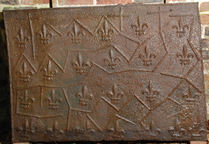
Description: Quasi-rectangular; twisted rope edging (top and sides); fleur-de-lys stamp repeated 25 times in four rows (6-6-6-7), interspersed with a length of twisted rope repeatedly stamped between each row and sometimes between fleurs; three rope crosses near top corners.
Notes: The fleurs are identical to others from the ‘Pounsley’ series.
- Decoration tags:
- rectangular (shape)
- rope (edging)
- simple stamps
- carved stamps
- heraldic
- objects
Manufactured: in the mid- to late-16th century possibly at Pounsley Furnace, Framfield in the Weald area of England.
Current location: Nymans, Staplefield Road, Handcross, Slaugham, West Sussex, England.
(part of the National Trust museum group)
- Attached to series:
- Pounsley series
- Fleur-de-lys firebacks
-
313
Description: Arched rectangular shape; cavetto moulded edging; date top centre within arch.
Notes: Plain elegant fireback from a late series, probably cast in the south east of England. The crack emanating from the top right corner of the fireback seems to be a weakness on all the recorded examples, and may have caused by thinness of the base board at that point.
Inscription: 1853
- Decoration tags:
- rectangular with round arch (shape)
- cavetto (edging)
- carved stamps
- individual numbers
- text
Manufactured: in 1853 in England.
Current location: Nymans, Staplefield Road, Handcross, Slaugham, West Sussex, England.
(part of the National Trust museum group)
- Attached to series:
- 1850s series
- Date only firebacks
-
101
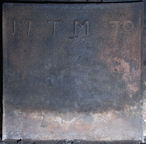
Description: Rectangular; cavetto moulded edging; date aplit by intitials placed centrally at top.
Inscription: 17 TM 70
- Decoration tags:
- rectangular (shape)
- cavetto (edging)
- individual letters
- individual numbers
- text
Manufactured: in 1770 possibly in the Weald area of England.
Current location: in private hands, Hartfield, East Sussex, England.
- Attached to series:
- Date & initials firebacks
-
1240
Description: Rectangular shape; twisted rope edging (top and sides); top centre, crowned shield bearing initials KH above a fleur-de-lys between an angled leopard passant guardant sinister (on the left) and an angled leopard passant (on the right); the group repeated below at a steeper angle; in each top corner, a crowned shield bearing initials KH, above a fleur-de-lys, the left shield over pressed.
Notes: One of a large series employing distinctive Tudor heraldic stamps. The absence of one of the legs of the leopard passant indicates that this is an example of a later use of the stamp, earlier castings showing the stamp in more complete condition. The only examples of this fireback that have been noted are similarly poor copies lacking definition. Other examples are at Sackville House, East Grinstead and at Nymans, Handcross, both in Sussex.
Copies of this fireback are known.
Inscription: KH [x4]
- Decoration tags:
- rectangular (shape)
- rope (edging)
- simple stamps
- carved stamps
- heraldic
- royal
- text
- objects
Manufactured: in the mid- to late-16th century in the Weald area of England.
Current location: in private hands, Hartfield, East Sussex, England.
- Attached to series:
- Royal series
-
1138
Description: Arched rectangular shape; twisted rope edging (top and sides); upper centre, date between shoulders of arch.
Notes: The numerals have been crudely impressed, probably using a pointed implement.
Inscription: 1658
- Decoration tags:
- rectangular with round arch (shape)
- rope (edging)
- individual numbers
- text
Manufactured: in 1658 in the Forest of Dean area of England.
Current location: in private hands, Hartpury, Gloucestershire, England.
- Attached to series:
- Date only firebacks
-
1243
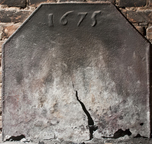
Description: Canted rectangular shape; twisted rope edging (top and sides); top centre, date '1675'.
Notes: Similar, in size, shape and position of numerals, to a fireback of 1670 but the numerals are from a different stock.
Inscription: 1675
- Decoration tags:
- rectangular with canted top corners (shape)
- rope (edging)
- carved stamps
- individual numbers
- text
Manufactured: in 1675 in England.
Current location: Harvington Hall, Chaddesley Corbett, Worcestershire, England.
(part of the Roman Catholic Archdiocese of Birmingham museum group)
- Attached to series:
- Date only firebacks
-
103
Description: Rectangular; flanged or astragal and fillett edging; female portrait in a medallion of three concentric rings; date split between four corners
Notes: An unusually small stoveplate.
Inscription: 1 6 [?0] 4
- Decoration tags:
- rectangular (shape)
- astragal & fillet (edging)
- whole carved pattern
- individual numbers
- pictorial
- text
- humans
Manufactured: in 1604 possibly in the Eifel area of Germany.
Current location: Haslemere Educational Museum, Haslemere, Surrey, England.
(part of the Haslemere Educational Museum museum group)
- Attached to series:
- Stoveplates
-
104
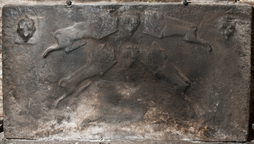
Description: 'Dutch' style; arched rectangular shaped central panel with arch at top; bead edging; female figure with staff and fan in a garden, inscription DER MITAG below figure ; similarly shaped border of Corinthian columns and floral decoration; symmetrical serpents on top.
Notes: The inscription means NOON; identified from a clearer version in the collection of the Haardplatenmuseum, Klarenbeek, Netherlands. The representations in human form of various virtues and vices in Iconologia, by Cesare Ripa, first published in the early 17th century but republished in different editions many times subsequently, formed the basis of the subject matter of several firebacks, mostly cast from continental originals, that became popular in England from the late 17th century.
Copies of this fireback are known.
Inscription: DER MITAG
- Decoration tags:
- 'Dutch' (shape)
- fillet (edging)
- whole carved pattern
- pictorial
- allegorical
- text
- humans
Manufactured: in the mid- to late-17th century possibly in the Siegerland area of Germany.
Current location: Haslemere Educational Museum, Haslemere, Surrey, England.
(part of the Haslemere Educational Museum museum group)
- Attached to series:
- 'Dutch' Miscellaneous Firebacks
-
107
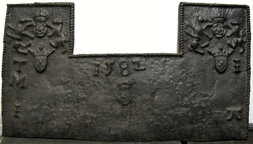
Description: Rectangle with two similar rectangular extensions at top extremities; rope edging (top and sides); on top extensions, two stamps of a dragon and lion supporting a rose and crown, each with a crowned shield bearing a fleur de lys below; central date with rose and crown below; initials TM vertically placed inside middle left edge, initial I middle right; initials I and A, respectively, at lower left and right.
Notes: The initials, TM and I, may relate to a married couple, the first two letters to their first names and the last to their surname; the initials IA are likely to be of the founder as they appear in the same arrangement on other firebacks. The unusual shape would probably have been determined by the structure of the hearth for which it was made; the rose and crown and supporters stamp can also be seen on a large fireback, dated 1593, formerly at Baynard's Park, Surrey (no. 200); the date and IA stamps can be seen, in identical form, on a fireback in the Victoria & Albert Museum, and on two other firebacks, suggesting a common source for all of these firebacks.
Inscription: TM 1582 I / I A
- Decoration tags:
- rectangular with two arches (shape)
- rope (edging)
- carved stamps
- individual letters
- individual numbers
- heraldic
- royal
- text
Manufactured: in 1582 possibly at Pounsley Furnace, Framfield in the Weald area of England.
Current location: Haslemere Educational Museum, Haslemere, Surrey, England.
Museum number: 8582 (part of the Haslemere Educational Museum museum group)
Citation: Anon., 1929, 'An interesting fireback', Sussex Notes and Queries, 2, 8 , p. 242.
- Attached to series:
- 1582 IA series
- Pounsley series