-
731
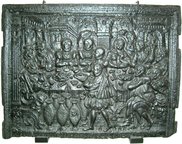
Description: Rectangular with flanged edging and a moulded frame; pictorial scene of the Marriage at Cana in an architectural setting; inscription along bottom edge.
Notes: The pattern-maker is believed to be Master Ronnung.
Inscription: HISTORIA VON DER HOCHZEIT ZV CANA IN GALILEA ...
- Decoration tags:
- rectangular (shape)
- flanged (edging)
- whole carved pattern
- pictorial
- biblical
- text
- humans
- objects
Manufactured: in the late-16th century possibly in the Harz area of Germany.
Current location: Victoria & Albert Museum, Cromwell Road, Kensington & Chelsea, Greater London, England.
Museum number: 319.1897 (part of the Victoria & Albert Museum museum group)
Citation: Dawson, C., 1903, 'Sussex Iron Work and Pottery', Sussex Archaeological Collections, 46, pp. 1-54.
Citation: Gardner, J. S., 1898, 'Iron Casting in the Weald', Archaeologia, 56, 1, pp. 133-164.
- Attached to series:
- Stoveplates
- Marriage at Cana stoveplates
-
732
Description: Rectangular; cavetto edging all round; seated lion on right, its tail rising above its back and its head turned to face the viewer; a seated sheep on the left.
Notes: Intended to represent the saying, ‘The lion shall lie down with the lamb’, a popular misquotation of Isaiah 11: 6. Some variants are dated 1679 (see no. 481).
Copies of this fireback are known.
- Decoration tags:
- rectangular (shape)
- cavetto (edging)
- whole carved pattern
- pictorial
- biblical
- animals
Manufactured: in the mid- to late-17th century in the Weald area of England.
Current location: Victoria & Albert Museum, Cromwell Road, Kensington & Chelsea, Greater London, England.
Museum number: 894.1901 (part of the Victoria & Albert Museum museum group)
- Attached to series:
- Small cavetto series
- Old Testament & Apocrypha firebacks
-
733
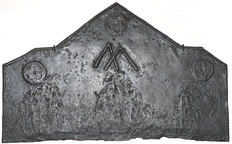
Description: Rectangular with canted top corners and a triangular extension from the top edge; twisted rope edges to all sides except bottom; a circular wafering iron or butter mould stamp, incorporating a square design with a fleur-de-lys on each side, repeated thrice, one at the apex and one below each of the canted corners; two inverted ‘V’ rope shapes overlapping to make an ‘M’ below top stamp.
Notes: The inverted double 'V' may be apotropaic, invoking the protection of the Virgin Mary; the circular stamp has also been noted on a Pelham-associated fireback of 1642 (no. 1204) which may suggest that it was a product of one of the family's ironworks.
- Decoration tags:
- rectangular with triangular arch (shape)
- rope (edging)
- simple stamps
- apotropaic
- objects
Manufactured: in the late-16th to early-17th century possibly at Waldron Furnace in the Weald area of England.
Current location: Victoria & Albert Museum, Cromwell Road, Kensington & Chelsea, Greater London, England.
Museum number: 895.1901 (part of the Victoria & Albert Museum museum group)
Citation: Page, S. & Wallace, M. (eds.), 2018, Spellbound (Oxford, Ashmolean Museum), p. 72.
- Attached to series:
- Food mould stamp firebacks
- Rope design firebacks
-
734
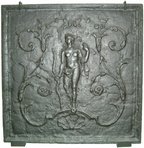
Description: Rectangular; wide fillet and cavetto-moulded edging; female figure holding a bow, with a quiver of arrows on her back, standing on a scallop shell; foliate swirls on each side.
Notes: The figure is that of Diana or Artemis.
- Decoration tags:
- rectangular (shape)
- fillet and cavetto (edging)
- whole carved pattern
- pictorial
- mythological
- humans
Manufactured: in the early-18th century in France.
Current location: Victoria & Albert Museum, Cromwell Road, Kensington & Chelsea, Greater London, England.
Museum number: M.114-1929 (part of the Victoria & Albert Museum museum group)
- Attached to series:
- Miscellaneous pattern firebacks
-
735
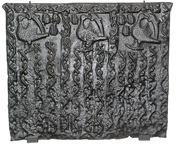
Description: Rectangular; three birds (probably swans, a Lancastrian badge) turned to the left, their heads facing right, and the front edge of their left wing extended and inverted; vine pattern strips, one horizontal along the top, and 14, of varied length, vertically across the rest of the fireback; seven ‘grape bunch’ shapes with criss-cross markings, arranged in three groups — 3-1-3 — adjacent to the birds.
Notes: The same vine strips are found on several firebacks, including some of the ‘Anne Forster’ series; the birds are also seen on a number of firebacks; the ‘grape bunch’ shapes may be the same as those on the ‘Anne Forster’ graveslab in Crowhurst church, Surrey. John Starkie Gardner and later writers attributed the birds to an association with the Fowle family; this is unlikely to be correct as the Fowles came to prominence in the iron industry towards the end of the sixteenth century and had their own distinctive decorative emblems. Formerly in the collection of Lady Dorothy Nevill.
- Decoration tags:
- rectangular (shape)
- complex, furniture-derived (edging)
- simple stamps
- carved stamps
- animals
- objects
Manufactured: in the mid- to late-16th century possibly at Pounsley Furnace, Framfield in the Weald area of England.
Current location: Victoria & Albert Museum, Cromwell Road, Kensington & Chelsea, Greater London, England.
Museum number: M.120-1914 (part of the Victoria & Albert Museum museum group)
Citation: Dawson, C., 1903, 'Sussex Iron Work and Pottery', Sussex Archaeological Collections, 46, pp. 1-54.
Citation: Gardner, J. S., 1898, 'Iron Casting in the Weald', Archaeologia, 56, 1, pp. 133-164.
Citation: Straker, E., 1931, Wealden Iron (London, Bell).
- Attached to series:
- Pounsley series
- Vine strip series
- Swan series
- Furniture stamp firebacks
-
736
Description: Other examples indicate that this fireback comprises at least four separate elements: the rectangular central panel has an anchor with coiled rope between two fleurs de lys, below which are two roses; this arrangement is repeated alongside; the two rectangular side panels each comprise a vertical stem with six ‘raspberries’ surmounted by a circular berry cluster; above, a semicircular arch contains the initials between two roses as in the central panel, with the date above; where the arch meets the central panel there is an arc across each corner; on the rectangular base panel, on a stippled ground, is a central six-pointed star and a four-strand root system beneath each of the stems in the side panels. The top and sides panels are edged with simulated twisted rope.
Notes: One of an unusual series formed from separate panels arranged, in this instance, with each vertical panel repeated. Because of its date and the use of the anchor motif, this much-copied plate is often referred to as the Armada fireback. No other connection with the sea battle is known. Other firebacks have been cast using some of the separate elements described above. The bottom panel which, unlike the other panels is separately edged with twisted rope, is likely to have been an addition to a copy of an earlier casting (no. 822) and not original.
Copies of this fireback are known.
Inscription: 1588 / IFC
- Decoration tags:
- rectangular with round arch (shape)
- simulated rope (edging)
- carved pattern panels
- text
- plants
- objects
Manufactured: in the late-16th century in the Weald area of England.
Current location: Victoria & Albert Museum, Cromwell Road, Kensington & Chelsea, Greater London, England.
Museum number: M.77-1957 (part of the Victoria & Albert Museum museum group)
Citation: Lloyd, N., 1925, 'Domestic Ironwork I', Architectural Review, 58, pp. 58-67.
- Attached to series:
- Armada series
-
737
Description: Armorial within complex ovolo moulded edging on all sides; two plank lines; the achievement is distinguished by the elaborately festooned mantling, the whole resting on a boat-shaped compartment.
Notes: The arms are of an esquire, and the crest - on a chapeau a wyvern, wings elevated and tail nowed, ducally gorged - matches that of the Trevor family of Trevalyn and Plas Teg. The shield is probably of impaled arms, i.e. those of a husband on the left and wife on the right. The husband's arms include several quarters with lions rampant, which were often a feature of the arms of Welsh families (of which the Trevors were one). The first quarter of the wife's arms is also of a wyvern, but the arms as a whole have not be identified. They have been variously, but incorrectly, attributed to John Trevor who married Elizabeth Morley, née Clarke, to Lord Dacre (a descendant of John Trevor), and to Col. Marcus Trevor, 1st Viscount Dungannon (peers' arms have supporters). The distinctive shape is seen in similar form on several other armorial firebacks from the mid-16th to 17th centuries, suggesting a continuity of pattern making, if not the same pattern maker. Many copies of this fireback exist.
Copies of this fireback are known.
Arms: prob. Trevor
- Decoration tags:
- complex quasi-arched (shape)
- ovolo (edging)
- whole carved pattern
- planklines
- armorial
Manufactured: in the mid- to late-17th century in the Weald area of England.
Current location: Victoria & Albert Museum, Cromwell Road, Kensington & Chelsea, Greater London, England.
Museum number: 142.1892 (part of the Victoria & Albert Museum museum group)
Citation: Gardner, J. S., 1898, 'Iron Casting in the Weald', Archaeologia, 56, 1, pp. 133-164.
- Attached to series:
- Ornate border series
- Personal armorial firebacks
- Welsh armorial firebacks
-
739
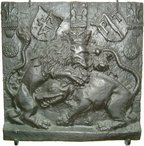
Description: Rectangular; a crowned lion fighting a boar in high relief on a raised bottom panel; above, a stamp formed from a fleur-de-lys on a bracket repeated three times, centre left and right corners; two angled shields and two sunburst discs.
Notes: The shields probably signify civic or personal allegiance; the symbolism of the fighting beasts is not known. Part of the bequest to the Victoria and Albert Museum by Lieut. Colonel G. B. Croft-Lyons in 1926.
Inscription: P T
- Decoration tags:
- rectangular (shape)
- none (edging)
- whole carved pattern
- heraldic
- armorial
- text
- animals
Manufactured: in the late-16th to early-17th century in Germany.
Current location: Victoria & Albert Museum, Cromwell Road, Kensington & Chelsea, Greater London, England.
Museum number: M.576-1926 (part of the Victoria & Albert Museum museum group)
- Attached to series:
- Foreign armorial firebacks
-
740
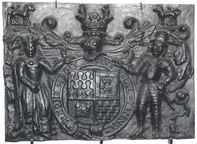
Description: Plain rectangular plate; shield, garter, helm, mantling and supporters of the Blount family, Lords Mountjoy.
Notes: The arms are those of Charles Blount, 8th Baron Mountjoy, who was invested Knight of the Garter in 1597. He was created 1st Earl of Devonshire in 1603. Blazon: 1. (Blount) Barry nebuly of six Or and Sable; 2. (Ayala) Argent, two wolves passant Sable on a bordure of the first eight saltires Gules; 3. (Mountjoy) Or a tower Azure; 4. (Gresley) Vair. An unusually bold and detailed casting; the buckle missing from the garter suggests that this plate has been cropped from a larger fireback.
Inscription: HONI·SOIT·QVI·MAL·Y·PENSE
Arms: Charles Blount, KG, 8th Baron Mountjoy
- Decoration tags:
- rectangular (shape)
- none (edging)
- whole carved pattern
- armorial
- text
Manufactured: in the late-16th to early-17th century in England.
Current location: Victoria & Albert Museum, Cromwell Road, Kensington & Chelsea, Greater London, England.
Museum number: 323.1907 (part of the Victoria & Albert Museum museum group)
- Attached to series:
- Personal armorial firebacks
- Mountjoy series
-
741
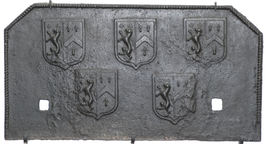
Description: Rectangular, with canted top corners; twisted rope edging (top and sides only); five shields of Ayloffe impaling Sulyard in two rows, 3-2; Ayloffe: sable, a lion rampant Or, collared gules, between three crosses formy of the second; Sulyard: argent, a chevron gules between three pheons inverted sable. Two cut notches probably for firedogs.
Notes: William Ayloffe (c1535-1584) of Bretons, Hornchurch, Essex, Justice of the Court of Queen’s Bench, married (c1560) Jane, dau. of Sir Eustace Sulyard, of Runwell, Essex. A large number of variants use the same shields. The excrescences affecting the left and right sides respectively of the lower shields are the result of inexpert ladling of the iron during casting. Part of the bequest to the Victoria and Albert Museum by Lieut. Colonel G. B. Croft-Lyons in 1926.
Arms: Ayloffe impaling Sulyard (William Ayloffe of Bretons, Hornchurch)
- Decoration tags:
- rectangular with canted top corners (shape)
- rope (edging)
- carved stamps
- armorial
Manufactured: in the early-17th century in the Weald area of England.
Current location: Victoria & Albert Museum, Cromwell Road, Kensington & Chelsea, Greater London, England.
Museum number: M.621-1926 (part of the Victoria & Albert Museum museum group)
- Attached to series:
- Ayloffe series
- Personal armorial firebacks
- Andiron slot firebacks