-
329
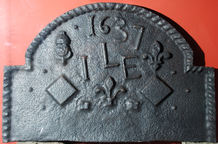
Description: Arched rectangular shape; simulated twisted rope edging (top & sides); central, symmetrical arrangement of a fleur-de-lys between two diamond stamps with two small cross-cut squares below, and a triad of dots outside; above, a haphazard arrangement of date, at top, above the initials, with a rose and crown to the left, and another fleur to the right.
Notes: Almost certainly an altered copy of a similar fireback dated 1613, some of the features of which have remained.
Inscription: 1637 / ILE
- Decoration tags:
- rectangular with round arch (shape)
- simulated rope (edging)
- carved stamps
- individual letters
- individual numbers
- heraldic
- text
Manufactured: in 1637 in the Weald area of England.
Current location: Horsham Museum, Causeway, Horsham, West Sussex, England.
(part of the Horsham Museum museum group)
- Attached to series:
- Diamond series
-
330
Description: Rectangular; plain edge; top centre, ring between repeated lion's head between repeated narrow human figure with folded arms standing on a bracket; below each figure, a small bracket.
Notes: The figures are indistinct and are disproportionately small for the size of the firebacks; from Isfield Place 1921.
- Decoration tags:
- rectangular (shape)
- none (edging)
- simple stamps
- carved stamps
- animals
- humans
- objects
Manufactured: in the late-19th to early-20th century in England.
Current location: Horsham Museum, Causeway, Horsham, West Sussex, England.
(part of the Horsham Museum museum group)
- Attached to series:
- Miscellaneous stamp firebacks
-
331
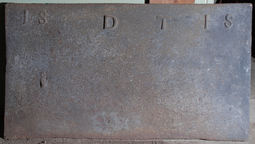
Description: Rectangular; no edging; inscription evenly spaced along top, sans serif lettering.
Inscription: IS D T IS
- Decoration tags:
- rectangular (shape)
- none (edging)
- carved stamps
- individual letters
- text
Manufactured: in the late-19th to early-20th century in England.
Current location: Horsham Museum, Causeway, Horsham, West Sussex, England.
(part of the Horsham Museum museum group)
- Attached to series:
- Initials only firebacks
-
332
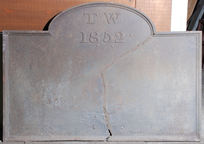
Description: Arched rectangular shape; cavetto moulded edging; top centre within arch, initials above date.
Notes: Plain elegant fireback from a late series, probably cast in the south east of England. The crack emanating from the top right corner of the fireback seems to be a weakness on all the recorded examples, and may have caused by thinness of the base board at that point.
Inscription: TW / 1852
- Decoration tags:
- rectangular with round arch (shape)
- cavetto (edging)
- individual letters
- individual numbers
- text
Manufactured: in 1852 in England.
Current location: Horsham Museum, Causeway, Horsham, West Sussex, England.
(part of the Horsham Museum museum group)
- Attached to series:
- 1850s series
-
333
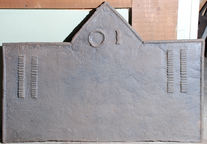
Description: Rectangular with triangular extension at middle of top edge; rope edging (top and sides); inscription in triangle - O larger than I; a pair of vertical, parallel ratchet bars (180mm long) below each top corner.
Inscription: O I
- Decoration tags:
- rectangular with triangular arch (shape)
- rope (edging)
- simple stamps
- text
- objects
Manufactured: in the late-16th to early-17th century possibly in the Weald area of England.
Current location: Horsham Museum, Causeway, Horsham, West Sussex, England.
(part of the Horsham Museum museum group)
- Attached to series:
- Miscellaneous stamp firebacks
-
325
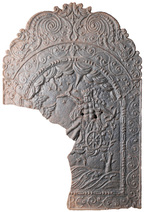
Description: Arched rectangular shaped central panel with bead-and-pellet edging on a broad fillet; Jupiter in his chariot drawn by eagles; above are clouds, below is a landscape; arched rectangular shaped border with fillet edging, with a symmetrical scrolled wire design; the monogram, SHR, bottom centre; above is a symmetrical design of scrolled floral tendrils.
Notes: The design is probably adapted from a personification of the planet, Jupiter, in 'Planetarum effectus et eorum in signis zodiaci', by Marten de Vos (1585). Two editions of engravings of de Vos's drawings are known, by Jan Sadeler, dated 1585, and by Gregor Fentzel in about 1650.
Inscription: SHR
- Decoration tags:
- 'Dutch' (shape)
- fillet (edging)
- whole carved pattern
- pictorial
- mythological
- allegorical
- text
- humans
Manufactured: in the late-17th to early-18th century in England.
Current location: Horsham Museum, Causeway, Horsham, West Sussex, England.
(part of the Horsham Museum museum group)
- Attached to series:
- SHR series
- British 'Dutch' style firebacks
- De Vos Planets series
-
327
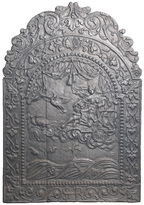
Description: Arched rectangular shaped central panel with open-bud edging; pictorial: Venus in her chariot drawn by doves, with her child, Cupid; a heron flies away to the left; above are swagged curtains and a pair of tassels, below is a landscape; arched rectangular shaped border with fillet edging, a scallop shell top centre with symmetrical arrangement of vine and acanthus leaves and tendrils; the monogram, SHR, bottom centre; above is a symmetrical design of scrolled floral tendrils.
Notes: The design is derived from a personification of the planet Venus in 'Planetarum effectus et eorum in signis zodiaci', by Marten de Vos (1585). Two editions of engravings of de Vos's drawings are known, by Jan Sadeler, dated 1585, and by Gregor Fentzel in about 1650. The flying heron has been copied from a print by Wenceslaus Hollar c.1658. The theft, in 1699, from a Thames-side warehouse of several firebacks, included '6 of Venus in a Chariot with Doves', which is likely to refer to this type (Post Boy 11-14 Nov. 1699).
Copies of this fireback are known.
Inscription: SHR
- Decoration tags:
- 'Dutch' (shape)
- fillet (edging)
- whole carved pattern
- planklines
- pictorial
- mythological
- allegorical
- text
- animals
- humans
Manufactured: in the late-17th century in England.
Current location: Horsham Museum, Causeway, Horsham, West Sussex, England.
(part of the Horsham Museum museum group)
- Attached to series:
- SHR series
- British 'Dutch' style firebacks
- De Vos Planets series
-
951
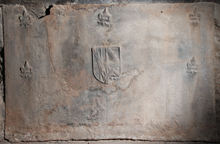
Description: Rectangular; central shield; fleur-de-lys stamp repeated three times across top and once on each side level with shield, all regularly spaced.
Notes: It is likely that the arms relate to the marriage, in 1541, of Christopher Sackville (c.1519-1559), son of John Sackville of Chiddingly, Sussex, and Constance Colepeper, daughter of Thomas Colepeper of Bedgebury, Kent, one of whose ancestors was the heiress, Elizabeth Hardreshull. The blazon: Sackville - quarterly or and gules, a bend vair; Colepeper - argent a bend engrailed gules; Hardreshull - argent a chevron sable between nine martlets gules, six and three. Christopher Sackville's brother, Sir Richard, owned Horsted Keynes furnace, which may have been where this fireback was cast. A candidate for the earliest English fireback with an example of personal arms.
Arms: Sackville impaling Colepeper and Hardreshall
- Decoration tags:
- rectangular (shape)
- none (edging)
- carved stamps
- heraldic
- armorial
Manufactured: in the mid-16th century possibly at Horsted Keynes Furnace in the Weald area of England.
Current location: in private hands, Horsted Keynes, West Sussex, England.
- Attached to series:
- Personal armorial firebacks
- Sackville firebacks
-
1126
Description: Canted rectangular shape; twisted rope edging (top and sides); cavetto-moulded-edged rectangle top centre, enclosing date between initials CT; five shields of Ayloffe impaling Sulyard in two rows (3-2); Ayloffe: sable, a lion rampant Or, collared gules, between three crosses formy of the second; Sulyard: argent, a chevron gules between three pheons inverted sable.
Notes: William Ayloffe (c1535-1584) of Bretons, Hornchurch, Essex, Justice of the Court of Queen’s Bench, married (c1560) Jane, dau. of Sir Eustace Sulyard, of Runwell, Essex. The initials 'CT' are likely to be those of Charles Tyler, a founder whose working life and that of his family have strong parallels with the occurrence of these firebacks. The smallest dated example in this series.
Inscription: C.1.6.0.9.T
Arms: Ayloffe impaling Sulyard (William Ayloffe of Bretons, Hornchurch)
- Decoration tags:
- rectangular with canted top corners (shape)
- rope (edging)
- carved stamps
- individual letters
- individual numbers
- heraldic
- armorial
- text
Manufactured: in 1609 possibly at Bedgebury Furnace, Goudhurst in the Weald area of England.
Current location: The Crown Inn, The Green, Horsted Keynes, West Sussex, England.
- Attached to series:
- Ayloffe series
- Personal armorial firebacks
-
950
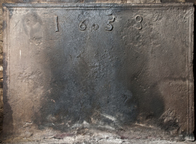
Description: Rectangular shape; ovolo-moulded edging (top and sides); date top centre.
Notes: The style of the numerals is identical to those seen on another fireback, indicating a common source.
Inscription: 1658
- Decoration tags:
- rectangular (shape)
- ovolo (edging)
- carved stamps
- individual numbers
- text
Manufactured: in 1658 possibly at Tintern Furnace in the Forest of Dean area of Wales.
Current location: in private hands, Horsted Keynes, West Sussex, England.
- Attached to series:
- Date only firebacks
- 1640-50s Dean series