-
243
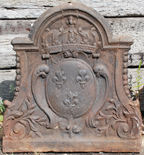
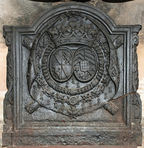
Description: Upon a rectangular base plinth, wide scrolled side fillets with foliage about the scrolls and suspended bell flowers in chain above; central cartouche behind an oval shield bearing three fleurs-de-lys surmounted by a French royal crown; on top, an arch rising from horizontal moulding on each side.
Notes: Characteristic of designs illustrated by architects such as Daniel Marot.
Arms: French royal
- Decoration tags:
- rectangular with round arch (shape)
- complex individual (edging)
- whole carved pattern
- planklines
- armorial
- royal
Manufactured: in the late-17th to early-18th century in France.
Current location: not known.
Citation: Carpentier, H., 1912, Plaques de Cheminées (Paris, published by the author).
- Attached to series:
- Foreign armorial firebacks
-
244
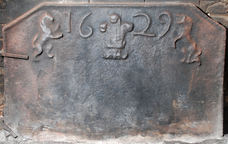
Description: Canted rectangle; twisted rope edging (top and sides); stamp of three ostrich feathers within a coronet, between the two parts of the date, with lion and unicorn supporters outside date.
Notes: The ostrich feathers are the badge of the Prince of Wales. There is no known significance of the year 1629 with that title, the birth of the prince (later Charles II) being in the following year. The date was probably added to a recasting of the plate. The lack of detail in the modelling indicates this has been recast several times.
Copies of this fireback are known.
Inscription: 16 29
- Decoration tags:
- rectangular with canted top corners (shape)
- rope (edging)
- carved stamps
- individual numbers
- heraldic
- text
- animals
Manufactured: in 1629 in the Weald area of England.
Current location: in private hands, Chailey, East Sussex, England.
Citation: Lloyd, N., 1925, 'Domestic Ironwork I', Architectural Review, 58, pp. 58-67.
- Attached to series:
- Prince of Wales' feathers series
- Prince of Wales firebacks
-
1034
Description: Canted rectangular shape; twisted rope edging in short lengths (top and sides); shield stamp with rebated edges repeated five times (two and three).
Notes: The arms are those of Courthope of Whiligh in Ticehurst; blazon: argent, a fess azure between three estoiles sable (two and one). Shown are molets of six points which have straight rays instead of (properly) estoiles which have wavy ones. However, the 1643/4 iron graveslab of David Barham of Snape, in Wadhurst church, has the same arms (also with molets instead of estoiles), which were those of his mother who was a Courthope.
Arms: Courthope, of Whiligh in Ticehurst
- Decoration tags:
- rectangular with canted top corners (shape)
- rope (edging)
- carved stamps
- heraldic
- armorial
Manufactured: in the late-16th to early-17th century in the Weald area of England.
Current location: Fulham, London, England.
- Attached to series:
- Personal armorial firebacks
- Courthope arms series
-
1255
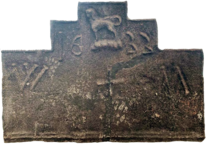
Description: Rectangular with two-stepped top; twisted rope edging (top and sides), reused frame moulding at bottom; top centre, stamp formed of a talbot statant guardant upon a wreath between separated date; initials formed of straight twisted rope lengths separated between lower shoulders; a cross below the crest.
Notes: Straight elements in the letters and numbers are formed of short lengths of twisted rope; curved elements appear to have been formed by hand drawing in the casting sand; the talbot crest has been seen on other firebacks indicating a common source, and is associated with firebacks with a stepped shape. Chard Auctions, 16 Mar 2023, lot 206 (£85, with two other firebacks).
Inscription: 16 33 / W + M
- Decoration tags:
- stepped (shape)
- rope (edging)
- simple stamps
- carved stamps
- individual letters
- individual numbers
- heraldic
- text
Manufactured: in 1633 in the Weald area of England.
Current location: not known.
- Attached to series:
- Stepped firebacks
- Talbot crest series
-
815
 ? x ? mmImage subject to copyright
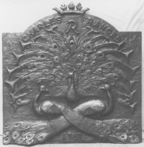
Description: Arched rectangular shape with crown, top centre; central peacock, its tail feathers displayed, with two other peacocks below, their tail feathers down; name across top of arch, split by initial, R; date ato bottom below tail feathers.
Notes: Manufactured by Seager's of Dartford, Kent
Inscription: CHARLES FRANCIS / R / 1967
- Decoration tags:
- rectangular with round arch (shape)
- none (edging)
- whole carved pattern
- pictorial
- text
- animals
Manufactured: in 1967 in England.
Current location: not known.
- Attached to series:
- Personal firebacks
-
245
Description: Arched rectangular shaped with narrow shoulders; fillet edging; date in individual numerals across arch.
Notes: A larger version is different in the spacing of the numerals and the proportions of the plate. For another casting of this fireback see J. Every Collection catalogue #20 (Sussex Archaeological Society library, Barbican House, Lewes, Sussex).
Copies of this fireback are known.
Inscription: 1658
- Decoration tags:
- rectangular with round arch (shape)
- rope (edging)
- carved stamps
- individual numbers
- text
Manufactured: in 1658 possibly in the Weald area of England.
Current location: Lytes Cary Manor, Charleton Mackrell, Somerset, England.
Museum number: 254606 (part of the National Trust museum group)
- Attached to series:
- 1658 arched series
- Date only firebacks
-
1084
 ? x ? mmImage subject to copyright
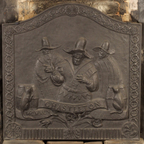
Description: Ogee-arched rectangular shaped central panel with fillet edging; pictorial scene with three figures dressed in clothing of the early 17th century, with wide-brimmed hats, the central figure to the fore and wearing doublet and belt, the two others in coats; across the bottom a trpartite scroll bearing the inscription CHASTLETON on the upper part, and the date MCMXCV and C of A (Charteris of Amisfield) & [illegible] R split between the lower parts, with three tulips beneath; resting on each outer part of the scroll, a barrel with a cat; an ogee-arched rectangular border with fillet edging with floral guilloche decoration and daisy flowers at the top and in the top corners; in the bottom left corner the circular badge of the National Heritage Memorial Fund, and in the bottom right corner the circular badge of the National Trust.
Notes: This fireback was cast for Martin, Lord Charteris of Amisfield (1913-99), Trustee of the National Heritage Memorial Fund, from a pattern he designed and made, to commemorate the 390th anniversary of the Gunpowder Plot; cast with figures associated with Robert Catesby, owner of a previous house on the site and one of the chief conspirators, and the cats belonging to the then owner, Mrs Barbara Clutton-Brock.
Inscription: CHASTLETON / MCMXCV / C of A & [?]R
- Decoration tags:
- rectangular with round arch (shape)
- fillet (edging)
- whole carved pattern
- pictorial
- text
- animals
- humans
- plants
- objects
Manufactured: in 1995 in England.
Current location: Chastleton House, Chastleton, Oxfordshire, England.
Museum number: 1430298 (part of the National Trust museum group)
- Attached to series:
- Martin Charteris firebacks
- Commemorative firebacks
-
874
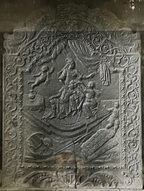
Description: Arched rectangular central panel with ovolo linking curves and eyelet astragal edging; pictorial scene of Delilah, seated above a pavement, supervising the cutting of Samson's hair by a barber, a putto to the left and a small figure lower right; drapery above; arched rectangular border with ovolo linking curves and fillet edging; symmetrical pattern of plant tendrils with leaves and seed pods; at bottom, monogram 'EB' in a cartouche between symmetrical leaves and ears of wheat; on top, two mirrored sea serpents.
Notes: One of a small series of firebacks identified by the EB monogram; the pictorial scene is of Delilah and the sleeping Samson with a Philistine cutting his hair; the scene may be based on an engraving by the Dutch artist Philip Galle (1537-1612) after a painting by Maerten van Heemskerck.
Copies of this fireback are known.
Inscription: EB
Manufactured: in the late-17th to early-18th century in England.
Current location: Chastleton House, Chastleton, Oxfordshire, England.
Museum number: 1430205 (part of the National Trust museum group)
- Attached to series:
- EB series
- Old Testament & Apocrypha firebacks
- British 'Dutch' style firebacks
-
957
Description: Upon a rectangular base plinth, an arched rectangular, ovolo-moulded panel containing a draped cloth (disclosing on the reverse the arms of Duras) upon which two oval shields are surmounted by a ducal coronet, and encircled by the collars of the Orders of St Michel and Saint-Esprit. Behind the cloth are crossed batons of a Marshal of France; on each side are flattened S-scrolls with tassels.
Notes: In all probability the arms of Jean-Baptiste de Durfort, Duc de Duras (1684-1770), created Marshal of France in 1741.
Arms: Durfort, duc de Duras
- Decoration tags:
- rectangular with round arch (shape)
- ovolo (edging)
- whole carved pattern
- armorial
Manufactured: in the early- to mid-18th century in France.
Current location: Chateau de Duras, Duras, Lot-et-Garonne, France.
- Attached to series:
- Foreign armorial firebacks
-
246
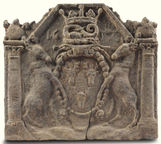
Description: Quasi-arched rectangular shape; on a ground, an armorial achievement comprising a central cartouche on which is an oval shield bearing the arms of the Cavendish family, with graduated bead edging; supporters, two stags rampant; above the cartouche, on a wreath a coiled snake crest surmounted by an earl’s coronet; the date split either side of the crest; to each side, a column with foliate capital supporting a three-sided arch with ovolo-moulded edging, on each shoulder of which is a flaming orb.
Notes: The arms are those of William Cavendish, 3rd Earl of Devonshire (1617-84). Sotheby's auction, The Chatsworth Attic Sale, 7 Oct 2010, lot 3 (£18,750).
Inscription: 1657
Arms: William Cavendish, 3rd Earl of Devonshire
- Decoration tags:
- rectangular with three-facetted arch (shape)
- complex individual (edging)
- whole carved pattern
- individual numbers
- armorial
- text
Manufactured: in 1657 in England.
Current location: not known.
- Attached to series:
- Personal armorial firebacks
- Cavendish arms series