-
238
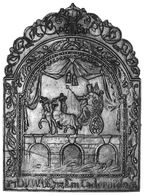
Description: Arched rectangular shaped central panel with bead-and-pellet edging on a wide fillet; crowned figure, holding a sceptre in his right hand, sitting in a chariot drawn to the left by two, caparisoned horses with ostrich feather head-dresses; the whole upon a three-arched bridge with keystones and a string course, waves beneath; above, swagged drapery with two tassels hanging from the centre; arched rectangular shaped border with fillet edging, symmetrical, descending oak leaf and acorn branches, with a looped 'W' in each shoulder; inscription at base; on top, symmetrical scrolled plant tendrils and berries. A single central vertical plankline.
Notes: One of a series produced in the same year. All incorporate the looped 'W' motif which may be intended to identify the pattern maker. The design is derived from a personification of Europe, one of a set of playing cards entitled Jeu de la Géographie, designed by Stefano della Bella for Louis XIV. The inscription translates as 'God is our strength'.
Copies of this fireback are known.
Inscription: 17 DVW Ydyw Ein Cadernid 24
- Decoration tags:
- 'Dutch' (shape)
- fillet (edging)
- whole carved pattern
- planklines
- pictorial
- allegorical
- text
- animals
- humans
- objects
Manufactured: in 1724 in England.
Current location: Tredegar House, Pencarn Way, Duffryn, Newport, Gwent, Wales.
Museum number: F81.233 (part of the Welsh National History Museum museum group)
- Attached to series:
- 1724 series
- Welsh inscription series
- British 'Dutch' style firebacks
-
239
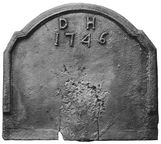
Description: Arched rectangle with stepped, canted shoulders; fillet and astragal edging (top and sides only); initials above date at top of plate.
Notes: The shape and edging are uncommon. Formerly from Caerphilly, Glamorgan.
Inscription: D H / 1746
- Decoration tags:
- rectangular with canted top corners and round arch (shape)
- fillet (edging)
- individual letters
- individual numbers
- text
Manufactured: in 1746 in Wales.
Current location: National History Museum, St Fagans, Glamorgan, Wales.
Museum number: 44.303/1 (part of the Welsh National History Museum museum group)
- Attached to series:
- Date & initials firebacks
-
1070
 ? x ? mm
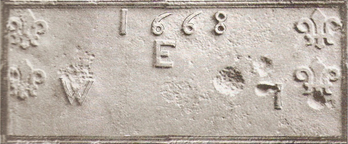
Description: Rectangular; ovolo-moulded edging; two fleurs-de-lys arranged vertically top left and top right; top centre, date; below date, initials WEI in triad.
Notes: Said to have been made by George White, iron founder, of Monmouth. Formerly from Newport, Monmouthshire.
Inscription: 1668 / W E I [triad]
- Decoration tags:
- rectangular (shape)
- ovolo (edging)
- carved stamps
- individual letters
- individual numbers
- heraldic
- text
Manufactured: in 1668 possibly at Tintern Furnace in the Forest of Dean area of Wales.
Current location: National History Museum, St Fagans, Glamorgan, Wales.
Museum number: 25.21 (part of the Welsh National History Museum museum group)
Citation: Kissack, K., 2003, Monmouth and its Buildings (Almeley, Logaston Press).
- Attached to series:
- Miscellaneous stamp firebacks
- Fleur-de-lys firebacks
-
240
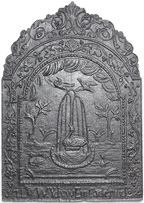
Description: Arched rectangular shaped central panel with bead-and-pellet edging on a wide fillet; ground with birds, and trees behind; in the centre a circular fountain rim with a swan on a plinth surrounded by water, with jets of water rising from the swan’s mouth and descending on either side; above, a heron and a goose fly to the left; under the arch, swags of drapery; arched rectangular shaped border with fillet edging, symmetrical floral fronds descending from a scallop shell, top centre, with a looed 'W' in each shoulder; inscription at base between date; on top, symmetrical scrolled plant tendrils. A single central vertical plankline.
Notes: One of a group of firebacks, all of the same date, some of which have the same Welsh inscription which translates as 'God is our strength'. All incorporate the looped 'W' motif which may be intended to identify the pattern maker. The design is adapted from an illustration of fountain no. XXXIX, 'Les Cannes et le Petit Barbet' in Labyrinthe de Versailles by Sébastien le Clerc (1677); the flying heron and duck are copied from illustrations by Francis Barlow (c1626-1704) or from engravings of his work by Wenceslaus Hollar (1607-77).
Copies of this fireback are known.
Inscription: 17 DVW Ydyw Ein Cadernid 24
- Decoration tags:
- 'Dutch' (shape)
- fillet (edging)
- whole carved pattern
- planklines
- pictorial
- architectural
- text
- animals
- objects
Manufactured: in 1724 in England.
Current location: Newton House, Dinefwr, Llandeilo, Carmarthenshire, Wales.
Museum number: F83.116 (part of the Welsh National History Museum museum group)
Citation: Lloyd, N., 1925, 'Domestic Ironwork I', Architectural Review, 58, pp. 58-67.
- Attached to series:
- 1724 series
- Welsh inscription series
- British 'Dutch' style firebacks
-
997
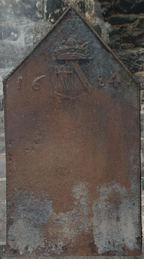
Description: Triangular arched shape; twisted rope edging (top and sides); top centre, shield and marquesal coronet separating two halves of date.
Notes: The arms are of Charles Paulet, 6th Marquess of Winchester (c1630-99) who married, secondly in 1655, Mary Carey, illegitimate daughter of Emanuel Scrope, 1st Earl of Sunderland and 11th Baron Scrope of Bolton; blazon: (Paulet) Sable, three swords pilewise points in base proper pommels and hilts or; (Scrope) Azure, a bend or.
Inscription: 16 84
Arms: Paulet impaling Scrope (Charles Paulet, 6th Marquess of Winchester)
- Decoration tags:
- triangular arched (shape)
- rope (edging)
- simple stamps
- carved stamps
- armorial
- text
Manufactured: in 1684 in England.
Current location: Bolton Castle, Castle Bolton, North Yorkshire, England.
- Attached to series:
- Personal armorial firebacks
- Paulet firebacks
-
1282
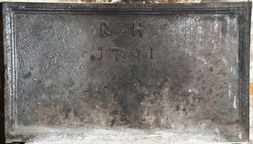
Description: Rectangular shape; wide fillet and ogee-moulded edging; approximately top centre, initials RH, with date 1701 centred below.
Notes: The character set for the initials and date lacks uniformity, some carved crudely, others more carefully; the lettering differs from another fireback (see no. 1166), with the same initials and date, by the position and shape of the letter 'R'. Formerly at Nethercote, Netherfield Hill, East Sussex. The former location in the Netherfield area of these two firebacks suggests a possible association with Richard Hay, owner of land in that area at that time and ironmaster at Beech Furnace nearby.
Inscription: R H / 1701
- Decoration tags:
- rectangular (shape)
- fillet and ogee (edging)
- carved stamps
- individual letters
- individual numbers
- text
Manufactured: in 1701 possibly at Beech Furnace, Battle in the Weald area of England.
Current location: in private hands, Catsfield, East Sussex, England.
- Attached to series:
- Date & initials firebacks
-
855
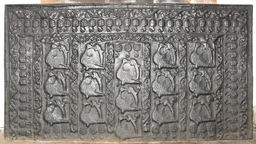
Description: Rectangular; twisted rope edging (top and sides); inner border of repeated strips of undulating vine tendril, inside of which are stamped panels of repeated grape bunches, totalling 27 along the upper edge and 13 down each side; inside them is a further border of vine strips within which are five columns of a bird stamp (probably a swan, a Lancastrian badge). each repeated three times, below each of which are three further grape bunch stamps except the middle column, where the grape bunches are above the swans.
Notes: A complex and well executed design incorporating three stamps found on many other firebacks.
- Decoration tags:
- rectangular (shape)
- rope (edging)
- carved stamps
- animals
- plants
Manufactured: in the late-16th century possibly at Pounsley Furnace, Framfield in the Weald area of England.
Current location: in private hands, Butleigh, Somerset, England.
- Attached to series:
- Pounsley series
- Vine strip series
- Swan series
- Furniture stamp firebacks
-
856
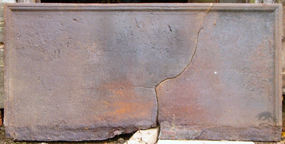
Description: Rectangular; ovolo-moulded edging (top and sides); otherwise plain.
Notes: A base board, possibly used for other firebacks.
- Decoration tags:
- rectangular (shape)
- ovolo (edging)
- whole carved pattern
Manufactured: in the 16th or 17th century possibly in the Weald area of England.
Current location: in private hands, Chailey, East Sussex, England.
- Attached to series:
- Base boards
-
241
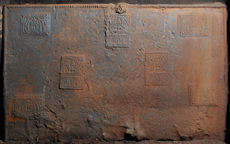
Description: Rectangular; twisted rope edging (top and sides); irregular arrangement of two rectangular pastry stamps, each with a fleur de lys within fern leaves, and one with three additional fern leaves below; the smaller stamps form the four corners, with the larger stamp, three times, in a triangular pattern between.
Notes: Various excrescences on the plate were probably the result of careless pouring of the metal during casting.
- Decoration tags:
- rectangular (shape)
- rope (edging)
- simple stamps
- objects
Manufactured: in the mid- to late-16th century possibly at Pounsley Furnace, Framfield in the Weald area of England.
Current location: in private hands Kensington and Chelsea, London, England.
- Attached to series:
- Pounsley series
- Food mould stamp firebacks
-
242
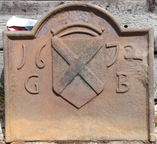
Description: Arched rectangular shaped; astragal edging; shield bearing a saltire, beneath a baron’s coronet; date and initials split by shield.
Notes: The shield, coronet and initials may be those of George Nevill, 12th Baron Bergavenny (1665-95); the Neville arms has a rose in the centre but if the shield were a painted carving, the rose may have been painted and not carved.
Copies of this fireback are known.
Inscription: 16 72 / G B
Arms: George Nevill, 12th baron Bergavenny
- Decoration tags:
- rectangular with round arch (shape)
- carved stamps
- individual letters
- individual numbers
- text
Manufactured: in 1672 possibly in the Weald area of England.
Current location: Fulham, London, England.
- Attached to series:
- Bergavenny firebacks
- Personal armorial firebacks