-
711
Description: Rectangular plate with plain ovolo-moulded edging, superimposed by a fireback with, on top, arched mirrored scrolls surrounding a scallop shell, and below, a conversational scene of a man and woman seated at a small table with a soldier standing to the right and a building and servant behind to the right.
Notes: A composite fireback presumably intended to extend the width of an existing small one; rivets repair a crack.
- Decoration tags:
- rectangular with ornate arch (shape)
- ovolo (edging)
- carved pattern panels
- composite
- pictorial
- humans
Manufactured: in the early- to mid-18th century in England.
Current location: not known.
- Attached to series:
- Late pictorial series (all)
- Composite firebacks
- Late pictorial series 4
-
977
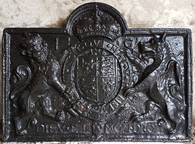
Description: Arched rectangular shape; ovolo moulded edging; Tudor royal shield, garter, crown, motto and supporters (crowned lion and dragon), temp. Elizabeth I; initials in space on either side of top of garter; the top of the lion's crown and the dragon's ear overlap the edging.
Notes: The initials have been added to an early recasting; another version has a rose and portcullis either side of the crown, and the top of the lion's crown and the dragon's ear do not overlap the edging.
Copies of this fireback are known.
Inscription: I G / [Garter] HONI SOIT QVI MAL E PENSE / [motto] DIEV ET MON DROIT
Arms: Tudor royal
- Decoration tags:
- rectangular with round arch (shape)
- ovolo (edging)
- whole carved pattern
- individual letters
- planklines
- armorial
- royal
- text
Manufactured: in the mid- to late-16th century possibly in the Weald area of England.
Current location: not known.
- Attached to series:
- Tudor royal armorial firebacks
- Tudor royal armorial (plain) series
-
1164
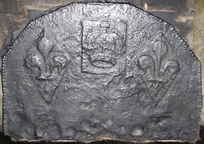
Description: Rectangular with 5-facetted arch; twisted rope edging; centre top, rectangular stamp, over-pressed, with crown above initials in bottom corners; diamond shaped stamp with fleur-de-lys repeated each side of crown, both over-pressed.
Notes: Notable for the large size of the fleur-de-lys stamp; this casting differs from another (no. 486) in the placement of the stamps. Formerly at Parsonage Farm, Steeple Bumpstead, Essex.
Inscription: E R
- Decoration tags:
- multi-facet arched (shape)
- rope (edging)
- simple stamps
- carved stamps
- heraldic
- royal
- text
- objects
Manufactured: in the mid- to late-16th century in the Weald area of England.
Current location: in private hands, Newmarket, Suffolk, England.
- Attached to series:
- Large diamond fleur series
- Fleur-de-lys firebacks
-
1202
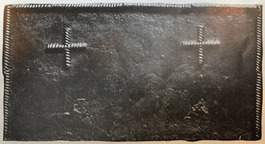 ? x ? mm
Description: Rectangular shape; twisted rope edging (top and sides); upper centre, two evenly-spaced, medium-sized twisted rope crosses.
Notes: Formerly (1950) at Maidstone, Kent. Illustration from Schubert, 1950.
- Decoration tags:
- rectangular (shape)
- rope (edging)
- simple stamps
- apotropaic
- objects
Manufactured: in the late-16th to early-17th century possibly in the Weald area of England.
Current location: not known.
Citation: Schubert, H. R., Aug 1950, ‘Old English Iron Firebacks’, Steel News, 2, 2, p. 8.
- Attached to series:
- Rope design firebacks
-
1033
Description: Arched rectangular shaped; fillet edging with embattled relief inside; shield, helm, crest and mantling of the Blacksmiths' Company. RN monogram in top right corner.
Notes: Arms of the Blacksmiths' company: Sable, a chevron Or between three hammers Argent and crowned with open crowns of the second; crest: a phoenix in flames rising proper. The arms were granted in 1611. Several different versions of these arms are to be found on firebacks. The attribution of this fireback to the series usually identified by the monogram RN is tentative, it being a copy and a substantial amount of surface detail imperfectly rendered.
Copies of this fireback are known.
Arms: Worshipful Company of Blacksmiths
- Decoration tags:
- rectangular with round arch (shape)
- embattled fillet (edging)
- whole carved pattern
- armorial
Manufactured: in the early- to mid-17th century possibly in the Weald area of England.
Current location: in private hands, not known.
- Attached to series:
- Livery company firebacks
- RN series
-
1254
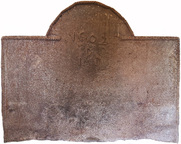
Description: Arched rectangular shape; twisted rope edging (top, and sides short of bottom), with shoulder edging extending into base of arch; upper centre, date '1602' slanting down to right; below date, initials 'IPD' in triad.
Notes: The initials are likely to be those of a couple whose surname begins with 'P'.
Inscription: 1602 / I P D [triad]
- Decoration tags:
- rectangular with round arch (shape)
- rope (edging)
- carved stamps
- individual letters
- individual numbers
- text
Manufactured: in 1602 possibly in the Weald area of England.
Current location: not known.
- Attached to series:
- Date & initials firebacks
-
1263
Description: Arched rectangular shaped central panel with hollow bead edging; a putto, its head inclined to its left, standing on a platform, holding a wand in its right hand and a branch in its left hand, a flower in a pot is on each side, and above, swagged drapery; arched rectangular shaped border with fillet edging; swirled flowers and tendrils symmetrically arranged, with SHR monogram at centre bottom; two mirrored stylised sea serpents on top; to each side a vertical extension with bead edging, of the same decoration as the side borders.
Notes: The figure depicted is probably emblematic although the meaning has yet to be determined. The frame of the central panel and the enclosing border are identical to those noted on another fireback displaying a figure of Pluto (see fireback no. 164). This may be an example of an image from one casting being superimposed within the frame of an earlier fireback. The border is identical to that seen on fireback no. 1220.
Inscription: SHR
- Decoration tags:
- 'Dutch' (shape)
- bead (edging)
- whole carved pattern
- extension panels
- pictorial
- allegorical
- monogram
- text
- humans
- plants
- objects
Manufactured: in the early-18th century in England.
Current location: not known.
- Attached to series:
- British 'Dutch' style firebacks
-
1286
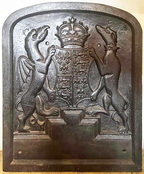
Description: Low-arched shape within broad fillet edging; on a plain field a Tudor royal shield, quarterly France Modern and England, supported by a stylised dragon and greyhound and surmounted by a crown, all resting on a two-stepped compartment with cavetto- and astragal-moulded edging at the top.
Notes: Pastiche 'Tudor' design by George Shaw of Saddleworth, Lancashire, c.1850, possibly intended to be passed off as genuine Tudor. Another casting in this form is to be found in The Guildhall, Lichfield. More decorated examples exist, with a leaf pattern on the edging and 'scales' on the dragon. Firebacks of the same armorial design within a different, arched rectangular, edging are known.
Copies of this fireback are known.
Arms: Tudor royal
- Decoration tags:
- rounded arched (shape)
- fillet (edging)
- whole carved pattern
- heraldic
- armorial
- royal
Manufactured: in the mid-19th century possibly in the Lancashire area of England.
Current location: not known.
- Attached to series:
- George Shaw series
- Tudor royal armorial firebacks
-
684
Description: Arched rectangular central panel with bead edging; an inverted, cabled anchor surmounted by a crown, flanked by one initial each side; arched rectangular border with cavetto-moulded edging; top centre, face of a putto with flowing leaf arrangement descending each side.
Notes: An English pastiche of the ‘Dutch’ style of fireback, which became popular in the second half of the seventeenth century. One of a small series of firebacks with similar proportions and detail. Copies of this fireback were advertised in the Wayte & Cheverton (Edenbridge) catalogue in the early-20th century.
Copies of this fireback are known.
Inscription: C R
- Decoration tags:
- rectangular with round arch (shape)
- cavetto (edging)
- whole carved pattern
- planklines
- heraldic
- text
- objects
Manufactured: in the mid- to late-17th century in England.
Current location: in private hands.
- Attached to series:
- Carolean 'Dutch' series
- Miscellaneous royal firebacks
-
464
Description: Arched rectangular shaped central panel, bead edging (top and sides), pedestal bearing a supine male figure with headband being trampled by a horse, facing left, mounted by a rider with long hair, facing to the front; on each side of the plinth is a seated figure with a basket of fruit; the inscription is split either side of the horse; arched rectangular shaped border, fillet edging, on each side a Solomonic column with vine decoration; in the arch, symmetrical parallel curved lines intertwined beneath a crown; on top of each shoulder of the plate a female figure in repose.
Notes: The equestrian figure is derived from the statue of Charles II erected in Stocks Market, London, in 1672. Originally to be of Jan Sobieski, later king of Poland, riding down a Tatar, it was altered to represent Charles, and the Tatar’s face was changed to that of Oliver Cromwell; the statue attracted a fair degree of derision. The 'CC' monogram is likely to be for Charles and Catherine (of Braganza). The statue is now at Newby Hall, near Ripon, North Yorkshire. Another version (no. 280), probably by the same pattern-maker, is dated 1674 and has altered initials.
Copies of this fireback are known.
Inscription: CC [interlocked, and the first reversed] R
- Decoration tags:
- 'Dutch' (shape)
- ovolo (edging)
- whole carved pattern
- individual letters
- pictorial
- historical
- text
Manufactured: in the mid- to late-17th century in the Weald area of England.
Current location: not known.
- Attached to series:
- Carolean 'Dutch' series
- Commemorative firebacks