-
802
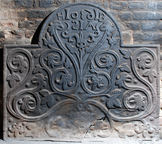
Description: Arched rectangular shaped; astragal edging (top and sides); mainly symmetrical vine arrangement, emerging from a vase, some fronds ending in an eagle’s head, other in leaves; at top of arch, initials ‘HB’ split by date (reversed) with an additional ‘I’; below, initials ‘AIS’ (reversed).
Notes: Two planklines; ‘HB’ refers to Henry Bell, who acquired Rake Manor, Witley, in 1592. ‘AIS’ refers to Anthony Smith, his nephew and heir, and his wife, Joan (née Hore); the form of the date is confused by the addition of an ‘I’, and the somewhat clumsy arrangement of the inscription suggests that it was added to the otherwise foliate pattern priot to casting. The letter 'H' seems to belong to a different character set
Copies of this fireback are known.
Inscription: H I0361B / AIS
- Decoration tags:
- rectangular with round arch (shape)
- astragal (edging)
- whole carved pattern
- planklines
- pictorial
- text
- plants
Manufactured: in 1630 possibly at Witley Park Furnace in the Weald area of England.
Current location: Rake Manor, Witley, Surrey, England.
Citation: Giuseppi, M. S., 1903, 'Rake in Witley [etc.]', Surrey Archaeological Collections, 18, pp. 11-60.
- Attached to series:
- Personal firebacks
- Miscellaneous pattern firebacks
-
943
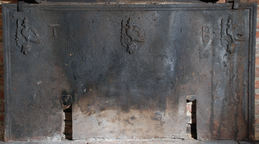
Description: Rectangular shape; ogee moulded edging (top and sides); crowned falcon stamp repeated three times and spaced evenly along the top; separated initials close inside outer falcon stamps; two andiron slots.
Notes: The stamp, which was originally a badge of Queen Anne Boleyn, and first used in the letters patent of her Marquisate of Pembroke, comprises a falcon with a crown upon its head and holding a sceptre, standing upon a tree stump, from which extends a sprig of red and white roses. The badge was later adopted by Queen Elizabeth I. The probability must exist that the initials TB relate to a member of the Boleyn family.
Inscription: T B
- Decoration tags:
- rectangular (shape)
- cyma reversa/ogee (edging)
- carved stamps
- individual letters
- heraldic
- historical
- text
- animals
- plants
- objects
Manufactured: in the 16th or 17th century in the Weald area of England.
Current location: in private hands, Woodchurch, Kent, England.
- Attached to series:
- Miscellaneous stamp firebacks
- Andiron slot firebacks
-
1260
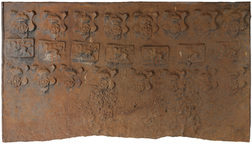
Description: Rectangular shape; twisted rope edging (top and sides); from top: rose and crown within a shield stamped eight times horizontally; rectangular stamp with a griffin passant repeated seven times horizontally; rose and crown within a shield stamped eight times horizontally.
Notes: Five other firebacks bearing these stamps are known: two are in Hastings, and one, dated 1569, is at Hadlow Down, Sussex. The locations of the other two, formerly in Ipswich and Guildford, are not known. Two excrescences on the lower part of the fireback show where the iron was poured, displacing the sand in the mould. Woolley & Wallis auction, Salisbury, 4 Apr 2023, lot 46 (£1,400).
- Decoration tags:
- rectangular (shape)
- rope (edging)
- carved stamps
- heraldic
Manufactured: in the mid- to late-16th century in the Weald area of England.
Current location: not known.
- Attached to series:
- Griffin series
-
1105
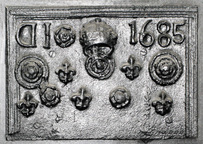
Description: Rectangular shape; cyma recta moulded edging (top and sides); top centre, rose and crown; top right, date; top left, initials, DI (with D reversed); small rose stamp between initials and rose/crown; concentric, rope-patterned roundel below date and below initials, with fleur-de-lys separating each from the rose/crown; below, uneven alternating line of three fleurs and two small rose stamps.
Notes: One of a series of firebacks cast between the 1670s and 1690s bearing small, simple stamps, initials and dates; the style of rose and crown is similar to that used in gun founding in the Tudor period, suggesting that the furnace that was the source of this fireback may have been previously used for that purpose.
Inscription: D [reversed] I 1685
- Decoration tags:
- rectangular (shape)
- complex, furniture-derived (edging)
- carved stamps
- individual letters
- individual numbers
- heraldic
- royal
- text
- objects
Manufactured: in 1685 in the Weald area of England.
Current location: Rowfant House, Worth, West Sussex, England.
- Attached to series:
- 1660s-90s Wealden series
- Fleur-de-lys firebacks
-
1303
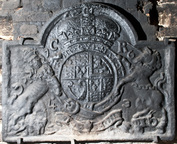
Description: Arched rectangular shape; cavetto edging; armorial; Stuart English royal arms within a circular garter; crown, motto and supporters (crowned lion and unicorn); initials separated by cro wn; date - 1643 - inserted outside Garter.
Notes: A widely copied fireback with the date, 1643, probably spurious, inserted when copied. An earlier casting without the date is no. 350.
Inscription: C R / 1 6 / HONI SOIT QVI MAL Y PENSE / 4 3 / DIEU ET MON DROIT
Arms: English Stuart royal
- Decoration tags:
- rectangular with round arch (shape)
- cavetto (edging)
- whole carved pattern
- individual numbers
- heraldic
- armorial
- royal
- text
Manufactured: in the mid-17th century in England.
Current location: in private hands, Worth, West Sussex, England.
- Attached to series:
- Carolean royal armorial firebacks
- Stuart royal armorial firebacks
-
636
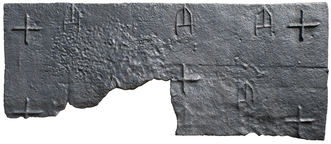
Description: Rectangular; no edging; quasi-symmetrical arrangement of crosses and buckle outlines: a cross at each corner and one to right of middle, three buckles along the top and three buckles in triad, level with, and below, the central cross; two horizontal plank lines; lower left part of back missing due to wear and corrosion. The fireback has a small accumulation of iron slag on the reverse side, probably caused by a failure, by the founder, to tap off all the slag from the furnace hearth before casting.
Notes: The buckles, which could have been stamped using a branding iron, suggest a connection with the Pelham family. This is the fireback noted in 1861 at Warbleton Priory, Sussex, which the Pelhams endowed in 1413; the priory was dissolved in 1535 suggesting that the fireback dates from before then. The excrescence, left of centre, on the surface of the fireback was probably caused by molten iron being poured from a ladle into the sand mould and displacing some of the sand.
- Decoration tags:
- rectangular (shape)
- none (edging)
- simple stamps
- carved stamps
- planklines
- heraldic
- objects
Manufactured: in the early- to mid-16th century in the Weald area of England.
Current location: Anne of Cleves House, Southover High Street, Lewes, East Sussex, England.
(part of the Sussex Archaeological Society museum group)
- Attached to series:
- Pelham family firebacks
- Metalware stamp firebacks
-
803
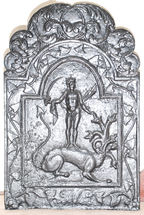
Description: Arched rectangular central panel, astragal and fillet edge, pictorial, Hercules, sword in hand, preparing to slay the Hydra; Arched rectangular border, fillet edge, ivy leaves and tendrils, monogram at bottom; swirled foliage on top.
Notes: The wooden pattern for this fireback (no. 927), formerly in the custody of William Hobday (d. 1883), last surviving ironworker at Ashburnham furnace, was given to the Sussex Archaeological Society by the Revd. J. Bickersteth. The fireback was previously at a house at Hooe, East Sussex.
Copies of this fireback are known.
Inscription: TAN
- Decoration tags:
- 'Dutch' (shape)
- fillet (edging)
- whole carved pattern
- pictorial
- mythological
- monogram
- text
- humans
Manufactured: in the 18th century at Ashburnham Furnace in the Weald area of England.
Current location: in private hands, Crawley, West Sussex, England.
Citation: Butterfield, W. R., 1916, 'Old Wealden Firebacks', The Connoisseur, 46, pp. 197-209.
Citation: Lloyd, N., 1925, 'Domestic Ironwork I', Architectural Review, 58, pp. 58-67.
Citation: Straker, E., 1931, Wealden Iron (London, Bell).
- Attached to series:
- TAN series
- British 'Dutch' style firebacks
-
1192
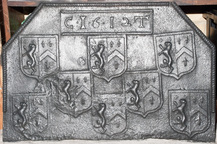
Description: Canted rectangular shape; twisted rope edging formed of six lengths of 23cm (top and sides); top centre, rectangular panel with cavetto-moulded edging (left side missing) enclosing date between initials CT, all interposed with dots; below, eight shields of Ayloffe impaling Sulyard in three rows (3-2-3); Ayloffe: sable, a lion rampant Or, collared gules, between three crosses formy of the second; Sulyard: argent, a chevron gules between three pheons inverted sable.
Notes: William Ayloffe (c1535-1584) of Bretons, Hornchurch, Essex, Justice of the Court of Queen’s Bench, married (c1560) Jane, dau. of Sir Eustace Sulyard, of Runwell, Essex. The initials 'CT' are likely to be those of Charles Tyler, a founder whose working life and that of his family have strong parallels with the occurrence of these firebacks. The excrescence affecting the left shield in the middle row and the blemish left of the middle shield in the top row are the result of inexpert ladling of the iron during casting. Previously at Smarden, Kent. The absence of the left side of the frame of the inscription panel has also been noted on another back in this series, also dated 1612.
Inscription: C.1.6.1.2.T
Arms: Ayloffe impaling Sulyard (William Ayloffe of Bretons, Hornchurch)
- Decoration tags:
- rectangular with canted top corners (shape)
- rope (edging)
- carved stamps
- individual letters
- individual numbers
- heraldic
- armorial
- text
Manufactured: in 1612 possibly at Bedgebury Furnace, Goudhurst in the Weald area of England.
Current location: in private hands, Crawley, West Sussex, England.
- Attached to series:
- Ayloffe series
- Personal armorial firebacks
-
1204
Description: Arched rectangular shape; ovolo moulded edging; date in arch; below arch two parallel, vertical straps, each with a buckle at the top and six prong holes; initials left and right of centre; in top corners, rectangular framed stamp with inset bird; top centre, to left and right of buckle, circular 'butter mould' stamp with stylised fleur-de-lys design, the left one angled top to left; between each initial and strap, rectangular framed stamp with inset deer with antlers, and star in top left corner; below this, adjacent to each strap end, a circular stamp with symmetrical pattern; to left and right of this, a rectangular stamp with an unidentified animal, possibly a dog..
Notes: The buckles, the date and the initials all appear to be separate stamps but attached to the base board before being impressed to form the mould, as they are identically positioned on all castings. The buckles suggest a connection with the Pelham family; the initials may relate to Sir Thomas Pelham, Bt. (1597-1654) who owned and operated ironworks at Waldron in Sussex. This would appear to be a casting of the original pattern with the addition of five pairs of stamps. The circular stamp with the symmetrical pattern is probably the same stamp that has been noted on an otherwise unrelated fireback (no. 733). Some of the stamps are seen in greater profusion on a fireback formerly at Huggetts Farm, Waldron, Sussex (no. 966) and drawn by Edward Hughes, of Heathfield, in a scrapbook of images compiled by J. Starkie Gardner. Nicholson's auction, Fernhurst, 3 Jul 2021, lot 100 (£5); Bellman's auction, Wisborough Green, 18 Feb 2025, lot 746 (£600).
Inscription: 1642 / T P
- Decoration tags:
- rectangular with round arch (shape)
- ovolo (edging)
- carved stamps
- whole carved pattern
- planklines
- text
- animals
- objects
Manufactured: in 1642 probably at Waldron Furnace in the Weald area of England.
Current location: not known.
- Attached to series:
- 1642 Pelham series
- Food mould stamp firebacks
- Pelham family firebacks
-
1304
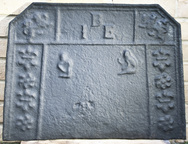
Description: Canted rectangular shape with inclined sides; cavetto-moulded edging (top and sides); horizontal fillet parallel to the top edge divided by two further fillets, in the centre the initials in capitals in triad, and at each end a lion rampant stamp facing inwards and inclined upwards towards the centre; below the lions, two inclined vertical fillets, parallel to the sides of the plate, each enclosing down the sides a double fleur-de-lys stamp and a flowerhead stamp repeated twice on each side and arranged alternately; in the panel below the initials, two different animal figures of indeterminate type, possibly monkeys.
Notes: The rampant lion, double fleur and flowerhead stamps have all been noted on other firebacks in a series identified on most backs with the initials I and B at the base of the plate. The initials are not present on this casting although the inclusion of I and B in the triad at the top could suggest that this fireback was personal to the founder and his wife. Of note are the impressions of the lions which overstamp the fillet below, indicating that they were placed after the fillet. Unlike the other backs in this series this example is undated. Wincanton Auctions, 24 Oct 2024, lot 540 (£35); Bellmans Auction, Wisborough Green, 13 May 2025, lot 562 (£60).
Inscription: IBE [triad]
- Decoration tags:
- rectangular with canted top corners (shape)
- cavetto (edging)
- carved stamps
- individual letters
- heraldic
- text
- animals
- plants
Manufactured: in the late-17th to early-18th century in the Forest of Dean area of England.
Current location: not known.
- Attached to series:
- IB series
- Fleur-de-lys firebacks